
Maine Coon winter adaptations: snowshoe paws, ear tufts and that coat
The first time my Maine Coon met proper snow, he did not hesitate at all. He stepped out, sank a little, lifted one huge paw to inspect it, and then carried on like the garden had been redecorated for him. Watching him, I finally understood that the fluff on this breed is not decoration.
Almost every famous feature has a winter job. The paw tufts, the tail, the layered coat and those pointed ears all make more sense once you see the cat use them outdoors. This is a tour of that toolkit, feature by feature.
It is also a reality check. These are helpful adaptations shaped by cold New England winters, not superpowers, and the last part of this article covers where the limits are. A well built Maine Coon still needs the same basic care in January as in July.
Where the limits actually sit
There is no single safe temperature for this breed, because wind, wet fur, age and health change the picture fast. A cat with a damp coat loses heat far faster than a dry one, which is why I judge the weather by conditions, not by the number on the thermometer.
Frostbite is the risk to watch on ears, paws and the tail tip. Ears that feel cold and stiff, or skin that looks pale or grey after an outing, are reasons to warm the cat gently indoors and call a vet for advice. Hypothermia shows as shivering that stops or unusual sleepiness, and it needs a vet straight away. Our overview of Maine Coon health problems lists the other warning signs that deserve a prompt call.
Where this winter kit came from
The breed developed in Maine, in the northeastern United States, where winters are long, wet and properly cold. Working farm cats that coped best with that climate were the ones that survived, bred and passed their traits on. You can read more of that story in our piece on the Maine Coon origin.
Breed associations still describe the cat in winter terms today. TICA, The International Cat Association, calls the Maine Coon a hardy breed well equipped to survive hostile New England winters, with a heavy, water resistant coat. That description matches the cat I live with far better than the gentle giant nickname does.
Selective breeding later made the cats bigger and more dramatic looking. The underlying equipment, though, stayed practical. Nothing on a Maine Coon is long, thick or tufted entirely by accident.
Snowshoe paws and toe tufts
Start at ground level, because that is where winter hits first. Maine Coon paws are unusually large and round for a domestic cat, and that size spreads the cat weight over a wider area. On soft snow, a wider paw sinks less, which is exactly why people compare them to snowshoes.
The comparison is not perfect, but it is fair. My cat crosses a snowy lawn in a few confident strides where a smaller cat picks its way along, shaking every foot. On a cleared path or hard ground the advantage disappears, and the big paws are simply big paws again.
Then there are the tufts between the toes. Long hairs grow out from between the toe beans and curl under the foot, adding insulation where fur is usually thin. They help keep the toes warm and give the paw a little extra structure on snow without adding much weight.
Those tufts do need a quick check after a snowy outing. Snow and ice can clump in the long hair between the toes, and packed clumps are uncomfortable to walk on. I wipe the paws dry at the door and gently tease out any clumps with my fingers, never by pulling hard.
Road salt and de-icer are a second winter hazard for those same paws. Salt dries and cracks the pads, and a cat who licks it off can swallow chemicals that irritate the stomach. A quick wipe with a damp cloth at the door takes care of most of it.
Antifreeze is the serious one, and winter is when it is most likely to be spilled in garages and driveways. Keep containers sealed and stored away, and wipe up any spill at once. If you ever think your cat may have walked through or licked some, call a vet immediately rather than waiting for symptoms. The ASPCA Animal Poison Control guidance is worth bookmarking before winter starts, because it lists what to do first in a poisoning scare.
Some Maine Coons go further and have extra toes, a trait called polydactyly that was common in the old Maine population. Extra toes make an already broad paw broader still. It is a charming bonus rather than a requirement, and plenty of ordinary toed Maine Coons manage snow perfectly well.
The tail that works as a scarf
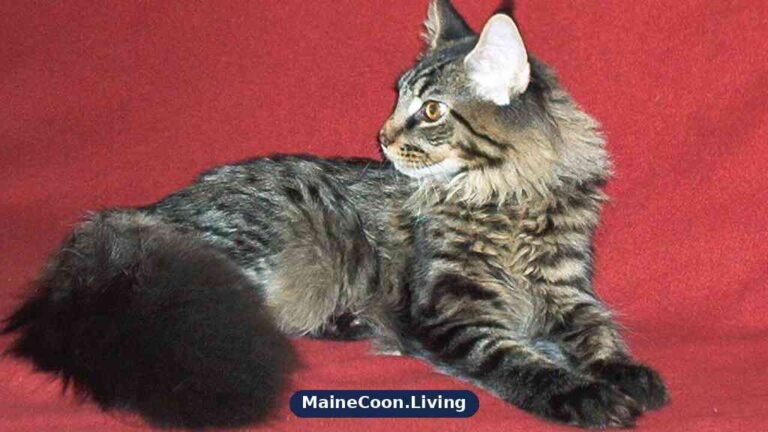
The tail is my favourite adaptation because you can watch it being used. It is long, wide at the base and covered in flowing hair, and a good one reaches at least to the shoulder when carried over the back. Curled around a resting cat, it covers the nose, the chin and one side of the face.
That is the scarf position, and cats settle into it on cold evenings indoors too. The tail traps a pocket of warmed air around the face and shields the nose from cold wind. Outdoors, the same tail can be curled under or around the body as an extra insulated layer between the cat and a frozen surface.
The long hair also resists sinking into snow in the first place. A resting cat on snow loses heat through whatever touches the ground, so a thick tail used as a cushion is doing real work. It is probably the clearest example of a show ring feature that started as pure function.

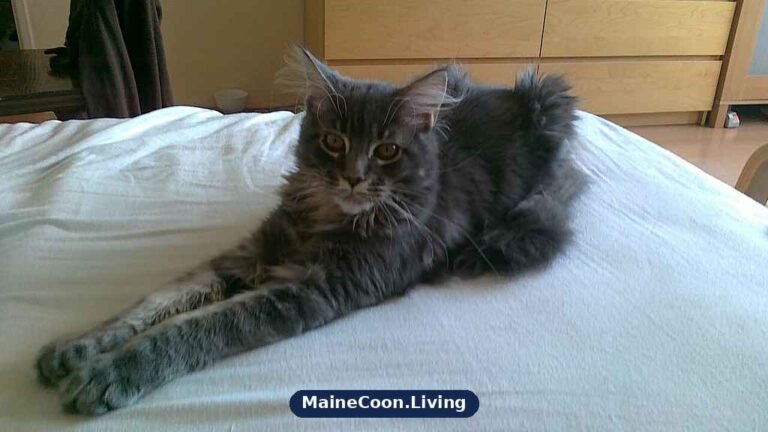
Even kittens show the beginnings of the equipment early. The tail plume, paw size and ear furnishings all grow in over the first couple of years, along with the rest of the cat. A youngster in its first winter has the design, just not yet the full insulation.
A coat built in layers
Run your hand against a Maine Coon coat in winter and you can feel that it is not one uniform layer of hair. Owners and groomers often describe it in three layers, and that is the easiest way to understand how it works. Each layer has a separate job.
- The outer guard hairs are the longest and glossiest, and they shed water so snow and rain run off instead of soaking straight through.
- The middle awn hairs add body and help hold the coat out from the skin, which keeps the layers underneath working.
- The soft, fine undercoat sits closest to the skin and traps warm air, and it is this layer that thickens most in winter.
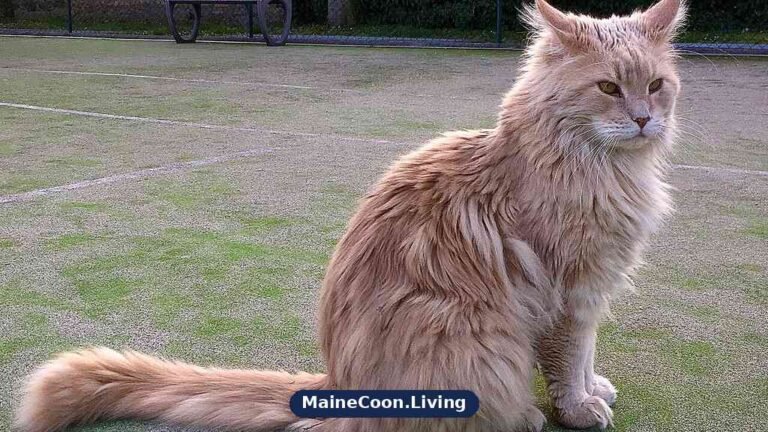
The coat is also cut unevenly, on purpose, if evolution counts as purpose. It is shorter on the head, shoulders and back, and much longer on the belly, flanks, chest and back legs. The long belly shag matters in snow, because the underside is what brushes through drifts and sits on cold ground.
Around the neck, many cats grow a ruff that works like the collar of a winter coat. It protects the throat and chest and gives the breed that lion like outline people love. If you want the full picture of how all these features come together, our guide to what a Maine Coon looks like walks through them one by one.
The coat changes with the seasons, too. It builds up through autumn, looks its most extravagant in midwinter, and then sheds as the weather warms. That seasonal cycle is normal, and it is why the answer to do Maine Coons shed a lot depends so much on the time of year.
One honest warning from experience: water resistant does not mean waterproof. A Maine Coon caught in cold rain, or one that falls into deep wet snow and stays there, will eventually get chilled like any other cat. Wet cold is far more dangerous to cats than dry cold, and it defeats this coat faster than anything else.
Water freezes, and cats still need to drink
An outdoor water bowl can freeze solid in an hour on a hard night, so a cat with garden access in winter can be thirsty without anyone noticing. Check any outdoor bowl twice a day, break the ice out, and refill with fresh water. A heated outdoor bowl is an option for a catio.
Snow is mostly air, it chills the mouth and stomach, and it does not replace a proper drink. Our Maine Coon cat care guide covers the daily water routine that works through every season, not just winter.
Ear furnishings and lynx tips
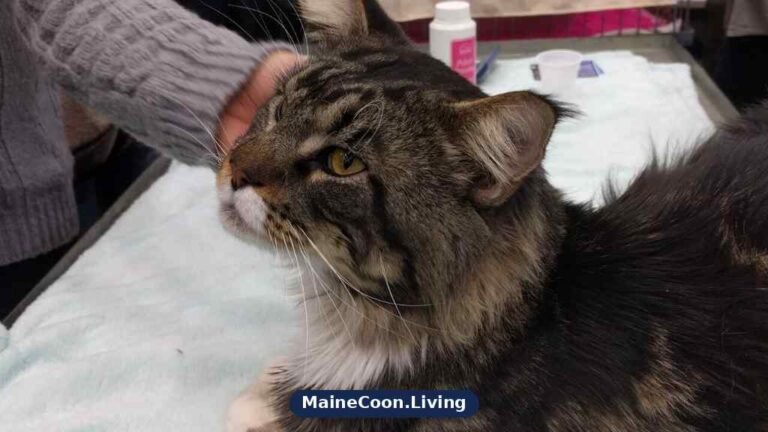
Look at the ears next, because they solve the opposite problem. Ears are thin, exposed and full of blood vessels close to the surface, so they lose heat quickly. Maine Coon ears are large, which should make that worse, so the breed wraps them in hair instead.
The inside of each ear carries heavy furnishings, long hairs that grow across and even out beyond the ear opening. That hair slows the wind, traps a layer of still air and keeps snow from settling directly into the ear. It is the same principle as the toe tufts, applied at the other end of the cat.
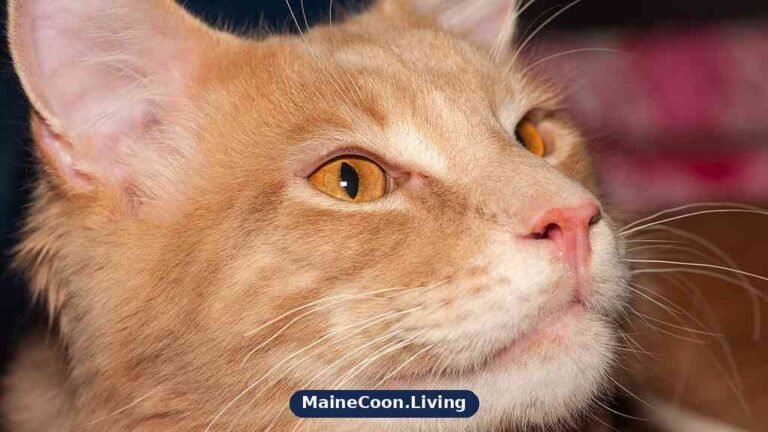
On top sit the lynx tips, the little points of hair extending from the ear tip that give the breed its wild expression. Their cold weather value is debated, and I think of them as mostly looks. The furnishings inside the ear do the practical work, while the tips do the posing for photographs.
Do not trim those ear hairs to tidy them up. They are part of how the ear protects itself, and cutting them back helps nobody. If you see scratching, head shaking, dark debris or a bad smell from an ear, that is not a grooming issue, so book a vet visit instead.
Videos of Maine Coons in snow show the whole system working at once. Watch the paws spread, the tail swing for balance, and the coat shrug off loose snow with every shake. It looks effortless because, for short outings, it mostly is.
Big body, slower heat loss
The last adaptation is the simplest: size itself. A large body holds more heat and has less surface area relative to its volume than a small body does. Heat escapes through the surface, so a big cat loses it more slowly, in the same way a large pot of soup stays warm longer than a small cup.
Maine Coons are among the largest domestic cat breeds, with a long, muscular, rectangular body and substantial bone. Males are usually noticeably bigger than females, and the breed matures slowly, often not filling out until three to five years of age. That bulk is not fat, and it should never be an excuse to let a cat get overweight.
There is a useful comparison here with other northern breeds. The Norwegian Forest Cat developed in a similarly harsh climate and arrived at many of the same answers, including a layered coat, tufted paws and a big frame. Similar winters tend to design similar cats, wherever in the world those winters are.
Kittens, seniors and thin cats do not get the full benefit of any of this. A kitten has less body mass and an unfinished coat, and an older cat may have health issues that make cold harder to handle. Judge winter outings by the individual cat in front of you, not by the breed average.
Kittens and seniors play by different rules
A kitten in its first winter has the design but not the full insulation. The coat is still growing in, the body is small, and the youngster tires faster in the cold. Keep first winter outings to a few minutes, always supervised.
Seniors need the opposite kind of care. An older cat may have stiff joints, a thinner coat, or a health issue that makes cold harder to handle, and the cold can make arthritis worse. Give a senior a warm bed away from draughts and shorter outings with a warm room waiting. Our notes on senior Maine Coon care cover the other cold weather changes worth watching for.
How they handle cold in practice
So what does all this equipment actually buy a pet cat? In my experience, it buys enthusiasm and a comfortable margin for short outings. It does not buy the ability to live outdoors, and it was never meant to in a modern pet home.
Most Maine Coons I know enjoy snow in bursts of about 10 to 20 minutes. They dig, pounce on falling flakes, follow their own tracks and explore, then head for the door ready to warm up. Mine announces clearly when he has had enough, usually by sitting at the door and complaining until it opens.
Choice is the key word in all of this. A cat who can come back inside whenever it wants will use its adaptations happily and safely. A cat shut outside cannot, and the same weather that was a game becomes a genuine risk.
Watch the behaviour, not the breed reputation. Ears pinned back against the wind, a tucked tail, constant paw lifting, shivering or frantic attempts to get in are all signs the outing is over. Bring the cat in, dry the coat and paws, and let them warm up somewhere comfortable.
Let me say this as plainly as I can: adaptation is not invincibility. Never leave a Maine Coon outside in severe cold, in a storm, or overnight in winter, whatever anyone tells you about the breed being built for it. Frostbite on ears and paws and hypothermia are real risks for domestic cats, and if you suspect either, contact a vet straight away.
Indoor winter care, minus the myths
Winter care for an indoor Maine Coon is mostly ordinary care done consistently. The myths tend to claim the breed needs either far more fuss or far less. The truth, as usual with this breed, sits in the boring middle.
Myth: the coat looks after itself
The winter coat is lower maintenance than many long coats, but it is not maintenance free. The thickened undercoat mats easily behind the ears, in the armpits and along the belly if it is left alone. A gentle brush through two or three times a week keeps loose hair moving out and lets you spot tangles early.
Myth: they drink less in winter, and that is fine
Heated indoor air is dry air, and cats still lose moisture and still need to drink properly. Keep bowls of fresh water topped up, and consider a second bowl away from the food if your cat drinks reluctantly.
Heated indoor air is dry air, and a thick coated cat feels it in the skin and the coat. Flaky skin, extra static when you brush, and more loose hair around the house are all common in heated rooms. A small humidifier in the room the cat sleeps in helps.
Watch the water intake as well as the coat. Some cats drink less in winter simply because they move less, and dry air takes moisture away at the same time. A second bowl in a different room often gets a reluctant drinker going again. Our guide to how to groom a Maine Coon cat covers the winter brushing rhythm that keeps the coat in shape.
If your cat stops drinking, eats much less or seems unwell, that is a vet conversation, not a winter quirk.
Myth: a winter cat wants to live outside
Enjoying a snowy garden and wanting to live in it are completely different things. Given the choice, every Maine Coon I have known picks the warm house, the radiator and the sofa for most of the day. Offer the outing, supervise it, and never feel you are depriving a cat by keeping it in during bad weather.
What actually helps in winter
- Brush regularly, and check the belly, armpits and behind the ears for early mats.
- Wipe paws after snowy outings and check between the toes for packed snow or ice.
- Keep fresh water available at all times, because dry heated air increases thirst.
- Keep play sessions going indoors, since a big, bored cat in winter will invent its own entertainment.
- Store antifreeze and winter chemicals well out of reach, and wipe up any spills at once.
That last point deserves emphasis. Antifreeze is extremely dangerous to cats, and winter is when it is most likely to be spilled in garages and driveways. Keep containers sealed and stored away, and if you ever think your cat may have walked through or licked some, call a vet immediately.
Enjoy the snow, respect the limits
I love winter with this breed, and I make no apology for it. Seeing those snowshoe paws, that scarf of a tail and the layered coat doing the jobs they were shaped for is one of the quiet pleasures of owning a Maine Coon. Few pet cats look so completely in their element.
The way to honour the design is to use it sensibly. Short outings, dry paws, an open door and a warm room waiting on the other side of it. Do that, and winter becomes enrichment for your cat instead of a risk you got away with.
Frequently Asked Questions
Can a Maine Coon live outside all winter?
No, and I would never ask mine to try. The coat and paws help with short, supervised time in cold weather, but a Maine Coon is a domestic cat who needs warm shelter, unfrozen water and a way back inside at all times. In severe cold, keep your cat indoors.
Do Maine Coons actually like snow?
Many do, at least in short bursts. Mine treats fresh snow like a new toy, pouncing, digging and shaking it off before trotting back to the door. Others take one look and choose the sofa, and that choice should always win.
How cold is too cold for a Maine Coon?
There is no single safe temperature, because wind, wet fur, age and health all change the picture fast. As a simple owner rule, if the weather feels harsh to you in a coat and gloves, your cat should be inside. If your cat is shivering, lethargic or has very cold ears or paws, warm them gently and call a vet for advice.
Why does my Maine Coon look bigger in winter?
You are mostly seeing coat, not extra cat. The undercoat thickens for the colder months and the longer guard hairs stand over it, which adds surprising bulk to the neck, belly and tail. The coat usually sheds and looks sleeker again as the weather warms.
Does central heating affect a Maine Coon coat?
Yes, dry heated air can leave the coat and skin feeling drier and can loosen more hair around the house. Keep fresh water available at all times, brush regularly to move loose hair out, and watch for mats behind the ears and under the legs. If you see flaky skin, bald patches or constant scratching, ask a vet to take a look.