Maine Coon Myths and Legends: Stories I Love, Truths I Trust
Every Maine Coon owner I know collects two things: loose fur, and stories. The fur turns up on every coat I own, and the stories turn up whenever a visitor meets my cat, stares at the ear tufts and asks if he is part wild animal.
I understand the question. A big, shaggy cat with a tail like a feather duster does not look like an ordinary pet, so people reach for an extraordinary explanation.
This post is my storytelling corner. Each legend below gets told properly first, because these tales deserve a fair hearing, and then it gets a clearly labelled verdict under the heading What is actually known.
One thing needs saying plainly at the start: legend is not evidence. If you want the documented record of where this breed really came from, read my separate post on the documented origin of the Maine Coon, which holds the facts and dates.
Here, we do the campfire version. I will tell you which stories I repeat with a smile, which ones contain a grain of truth, and which ones I would never pass on as fact.
Why This Breed Attracts Stories
Most cat breeds were designed on paper by breeders with a plan. The Maine Coon was shaped slowly by farms, ports and hard winters, and nobody kept tidy notes about its earliest years.
That gap in the record is an open invitation. Where paperwork is missing, imagination moves in, and a cat this theatrical gives the imagination plenty to work with.
I also think size plays a part. When a cat takes up most of a sofa, calling him a farm cat who survived some cold winters feels oddly flat, even when it is the truth.
Myth One: The Raccoon Romance
The oldest tale says that a domestic cat once wandered into the Maine woods and fell for a raccoon. Their kittens, so the story goes, were large and long coated, with ringed tails, masked looking faces and a talent for mischief.
People looked at those kittens and named them for both parents. Maine for the state where they were found, and coon for the wild father who supposedly started the whole line.
It is a tidy story, I will give it that. It explains the name, the tail and the tabby stripes in a single sentence, which is exactly why it has survived for so long.
What is actually known
Verdict: pure legend. A cat and a raccoon cannot have offspring together, because they are unrelated species with different chromosome counts and completely separate evolutionary histories.
No mating, however romantic the telling, gets around basic biology. Breeders, vets and geneticists are all in rare and total agreement on this one.
So where did the name probably come from? One popular theory credits a seafaring Captain Charles Coon, whose longhaired ship cats were said to have produced kittens in New England ports, so locals called the youngsters Coon’s cats.
That theory is unproven too, and I label it as such whenever I repeat it. A simpler possibility is that people named the cat after the animal its bushy, ringed tail reminded them of, the way we name many things by resemblance.
Myth Two: Marie Antoinette’s Escape Cats
Picture Paris in the early 1790s, with revolution in the streets and a queen running out of options. In the legend, Marie Antoinette plans a flight to America and arranges for her treasured belongings to be shipped ahead of her.
An American captain is named in many versions, and his vessel is said to have carried furniture, finery and a set of her favourite longhaired cats across the Atlantic. The queen never boarded, and history records what happened to her in France.
The cats, though, supposedly landed safely on the Maine coast. Left to breed with local shorthairs, they became the elegant ancestors of every Maine Coon alive today.
What is actually known
Verdict: legend, with no supporting evidence. Nobody has produced a cargo list, a letter or any account from the period that places royal cats on a ship bound for Maine.
The story also appears in print long after the events it describes. That late arrival is a classic warning sign, because genuine history usually leaves at least some trace at the time.
The honest kernel inside the tale is ordinary shipping. Longhaired cats genuinely did cross the Atlantic on merchant and settler ships throughout the 1700s, working as mousers and living as pets.
Some of those unknown ship cats may well sit far back in the Maine Coon family tree. They were working animals on working vessels, though, and the Cat Fanciers’ Association breed history sticks to that documented picture rather than the royal version.
Myth Three: Cats From the Viking Longboats
This is the story I find hardest to resist. Norse explorers crossed the Atlantic centuries before other Europeans, and their ships carried cats to keep rats away from food stores and rigging.
When a longboat crew went ashore, the tale says, some of those cats stayed behind. Big, weatherproof Scandinavian cats then met the cats of the new settlements, and the Maine Coon was the result.
Supporters point across the ocean for their evidence. Norway has its own shaggy giant, and the family likeness between the two breeds is strong enough to stop you mid sentence when you see them together.
What is actually known
Verdict: partly plausible, mostly unproven. Norse sailors really did keep cats, and Norse voyages really did reach North America, so the ingredients of the story are real.
What is missing is any link between those voyages and this breed. No record traces a line from a Viking landing to the farm cats of Maine several centuries later, and genetics has not supplied one either.
The confusion with the Norwegian Forest Cat does a lot of the heavy lifting here. Both breeds were shaped by cold northern climates, so both grew large bodies, dense coats, tufted ears and magnificent tails.
Similar weather can build similar cats without any shared voyage at all. If you enjoy the comparison, my guide to the Norwegian Forest Cat versus the Maine Coon shows where the two genuinely differ, from head shape to profile.
Myth Four: Part Lynx, Part Bobcat
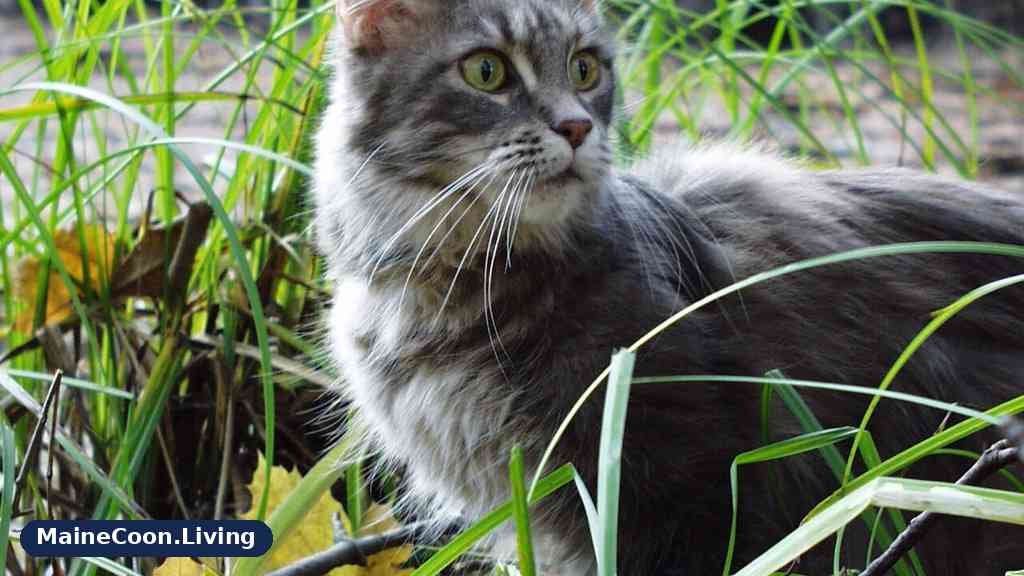
Show a stranger a Maine Coon in full winter coat and watch the guesses arrive. The ear tips end in long tufts, the paws look too big for a house cat, and the muzzle has a strong, square shape that photographs almost wild.
From there, the story writes itself. Somewhere back in the Maine woods, people say, a domestic cat must have crossed with a lynx, or perhaps with a bobcat, and the kittens kept the wild features.
I hear this one most often at the vet and in online groups. It usually comes from a place of pride, because owning a cat with a touch of the wilderness feels more exciting than owning a very large pet.
What is actually known
Verdict: legend. The Maine Coon is a domestic cat through and through, and no genetic evidence links the breed to lynxes, bobcats or any other wild species.
Those dramatic features have a practical explanation. Ear tufts help to shed snow and protect the ear tips, big paws with tufting between the toes spread weight on soft ground, and a heavy coat is winter equipment rather than wild heritage.
Bobcats and lynxes are separate wild species with their own behaviour and needs. A resemblance in a photograph is not a relationship, and my cat’s habit of staring out of the window does not make him a forest predator.
One genuinely unusual trait does need no myth at all. Extra toes turn up often in this breed’s history, and my post on the polydactyl Maine Coon explains that real quirk in full.
Myth Five: The 30 Pound Maine Coon
Every owner has seen the photograph. A person holds a cat at arm’s length, the cat fills the whole frame, and the caption claims a weight that would embarrass a medium sized dog.
Underneath, the comments divide into two camps. Half the readers are amazed, and the other half are busy accusing the owner of trickery, exaggeration or owning a small lynx after all.
This myth is different from the others, because it is still growing. The raccoon and the queen belong to the past, but the giant cat claim gets a fresh boost every time a new photograph goes viral.
What is actually known
Verdict: mostly exaggeration, built on a genuinely large breed. Maine Coons are among the biggest domestic cats, yet typical healthy adults are far lighter than the famous captions suggest.
Most adult males I have known sit somewhere around 13 to 18 pounds, with females nearer 8 to 12 pounds. My own cat feels enormous when he lands on my ribs at dawn, and even he is well inside that ordinary range.
The verified records are about length, not bulk. Stewie, a Maine Coon from Nevada, was measured at 48.5 inches from nose to tail tip and still holds the mark for the longest domestic cat ever recorded.
Barivel, an Italian Maine Coon, was confirmed at 47.2 inches as the longest living domestic cat. Notice that neither title rewards sheer weight, and record keepers dropped heaviest cat titles years ago to avoid encouraging owners to overfeed their animals.
That last point matters more than any photograph. Some celebrated giants are simply obese cats, carrying fat that shortens lives and strains joints, dressed up as breed size for an audience.
Camera tricks do the rest of the work. Holding a cat close to the lens while the owner leans back makes the cat look huge, a wide angle lens stretches the effect, and a thick winter coat adds inches of fluff in every direction.
If you want honest numbers instead of captions, my guide to how big Maine Coons really get sets out proper measurements, and the Maine Coon weight by age chart shows the slow growth curve month by month. These cats take years to mature, which is another reason patience beats boasting.
How I Tell These Stories Now
I have not stopped telling a single one of these tales. When friends ask about my cat’s ancestors, I still give them the queen, the Vikings and the raccoon, in that order, because the fun is real.
I have only changed the ending. Every story now finishes with its label attached: legend, partly plausible, or simply not known, and I find people enjoy the honesty as much as the tale.
That feels like the right way to honour this breed. The truth underneath, tough farm and port cats shaped by brutal winters, is a better story than any of the inventions, because those cats earned everything they became.
Frequently Asked Questions
Are Maine Coons really part raccoon?
No. Domestic cats and raccoons belong to different families, carry different numbers of chromosomes and cannot produce kittens together. The story grew from the breed name, the ringed and bushy tail and the tabby markings that can remind people of a raccoon.
Did Marie Antoinette’s cats really sail to Maine?
There is no evidence that they did. The tale says her longhaired cats were loaded onto a ship during the French Revolution, yet no record from the time supports it and the story surfaced much later. Ships certainly carried ordinary longhaired cats to New England, but nothing connects any of them to the queen.
Are Maine Coons descended from Viking cats?
It is possible in a loose sense, but it is not proven. Norse sailors kept cats and reached North America, and Maine Coons share distant links with Scandinavian longhairs. No record or genetic study can point to a Viking ship as the breed’s starting point, though.
Are Maine Coons part lynx or part bobcat?
No. Maine Coons are fully domestic cats, and no test or breeding record shows lynx or bobcat ancestry. Their ear tufts, large paws, strong muzzles and heavy winter coats explain the resemblance without any wildcat parentage.
Can a Maine Coon really weigh 30 pounds?
A very large, lean male can be genuinely heavy, but 30 pounds is far beyond the typical range for the breed. Most adult males weigh roughly 13 to 18 pounds and most females about 8 to 12 pounds. Many supposed 30 pound cats in photos are obese, held close to the camera, or both.