Maine Coon Litter Size: How Many Kittens Do They Have?
People ask me about litter size in a funny way, usually right after they have seen a photo of a Maine Coon surrounded by kittens. The picture makes it look simple, as if every queen just produces a neat pile of six. Real life, from everything I have learned as an owner, is a lot less tidy than that.
I am not a breeder, and I want to be upfront about that before anything else. What follows is what I have picked up from researching carefully, talking to breeders I respect, and following their litters over the years.
The honest average
If you need one number, use four. That is the average most experienced breeders plan around, and it matches what published breeding studies tend to find for this breed.
The normal spread around that average is wide. A healthy litter can hold anywhere from 1 to 12 kittens, although both ends of that range are unusual.
Most litters I hear about land between three and six. A litter of five does not surprise anyone, and a litter of two is not a problem that needs explaining either.
That wide range is the first thing worth accepting. Anyone who promises you an exact count before a scan is guessing, no matter how confident they sound.
It also helps to compare with cats in general. Domestic cats of all breeds average roughly four to five kittens, so Maine Coons sit right in that familiar territory despite their much larger adult size.
The breed’s big body does not buy a big litter. A Maine Coon queen is a large cat carrying kittens that are also relatively large at birth, and space inside is still space inside.
First litter vs later litters
First litters are usually the smallest. A young queen having kittens for the first time often produces just one to three, and breeders treat that as completely expected.
Her body is still finishing its own growth at that point. Maine Coons mature slowly, and a queen bred in her second year is not yet the finished adult she will become.
Second and third litters are often the biggest. Once a queen is fully mature and in her prime, commonly around two to five years old, her litter size tends to peak.
After that prime window, the numbers usually drift down again. Older queens conceive less reliably, carry fewer kittens, and need closer veterinary watching through pregnancy.
This pattern is why breeders read a first litter carefully but never judge a queen by it. One small first litter says almost nothing about what she will do next time.
It is also why good breeders retire queens at a sensible age. Pushing an older cat through litter after litter to chase numbers is exactly what responsible breeding is not.
What decides the number
Age and health of the queen
Age is the factor breeders mention first, with health right beside it. A queen in peak condition, at a healthy weight and up to date with her vet, gives a litter its best start.
Underlying illness quietly shrinks litters. Infections, poor body condition and untreated health problems can all reduce how many kittens are conceived or carried to term.
Genetics and family lines
Litter size runs in families, and breeders know their lines well. Some queens come from mothers and grandmothers who consistently had five or six, while other lines settle at two or three.
That history is one reason breeders keep such detailed records. Knowing what a line usually does helps them plan space, time and waiting lists with some honesty.
Season and daylight
Cats are seasonal breeders by nature, responding to longer days. Queens cycle more readily in spring and summer, and conception can be less predictable in the darker months for cats exposed to natural light.
Indoor queens under artificial light may cycle through much of the year. Even so, breeders still notice seasonal patterns in how easily queens conceive and how litters turn out.
The stud cat matters too
Half the genetics walk in on four male paws, and owners forget that. The stud’s age, health, fertility and how well the mating was timed all influence how many eggs get fertilised.
Cats release eggs in response to mating itself, which is unusual among pets. Repeated matings across a queen’s heat can therefore raise the number of kittens, while one poorly timed mating may produce a singleton.
None of these factors works alone, and that is the real lesson here. Any single litter is the product of age, health, genetics, season and the stud arriving at one combined result.
Big litters and the record question
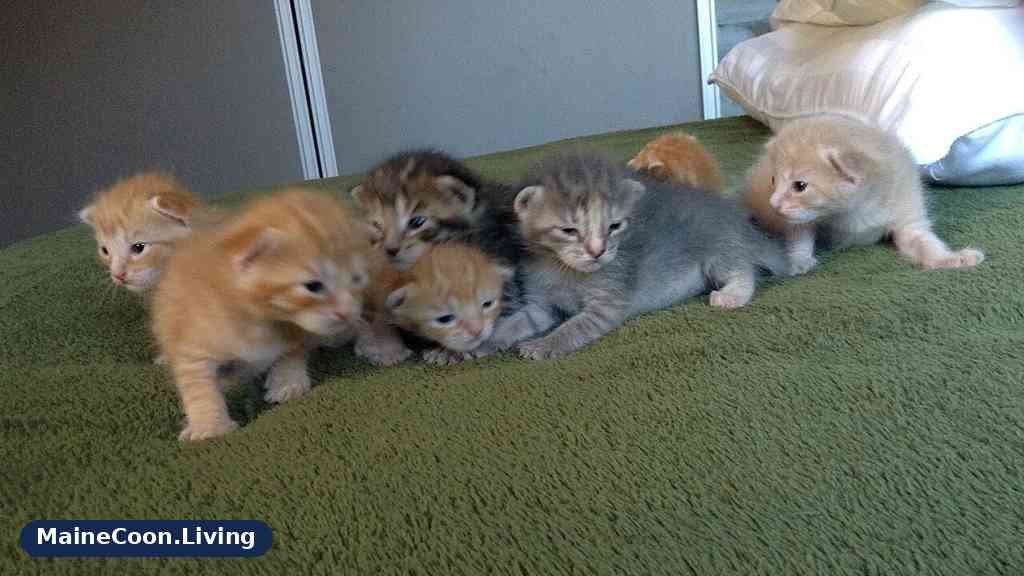
Every so often a breeder shares a litter of eight, nine or ten, and the photos travel fast. Those litters are real, but they are the exception that proves how normal four actually is.
Very large litters come with a cost that the photos never show. Kittens in big litters tend to be smaller at birth, compete harder for milk, and need far more human support in the first weeks.
Now for the record question, because people always ask it. I have looked, and there is no verified world record for the largest Maine Coon litter that stands up to proper scrutiny.
You will find websites stating precise record numbers with total confidence. When I have chased those claims back, they lead to other websites repeating them, not to a registry, a vet report or any primary source.
The honest version is this. Litters at the top of the documented range, around ten to twelve, are rare enough to be talked about for years, and anything beyond that should be treated as unproven until someone shows real evidence.
I would rather give you that boring answer than invent a number. Record claims about animals attract exaggeration the way litter photos attract shares, and this breed gets more than its share of both.
What breeders actually expect
Responsible breeders plan for fewer kittens than they hope for. It sounds pessimistic until you realise it is how they make sure every kitten who does arrive gets proper care and a proper home.
Most use ultrasound partway through pregnancy to confirm the queen is carrying and to check that things look healthy. Ultrasound is good for confirmation, but it is genuinely unreliable for an exact kitten count.
Later in pregnancy, many vets use an X-ray once kitten skeletons have mineralised enough to show. Counting skulls and spines on that image gives the clearest estimate, and even then a kitten can hide behind a sibling.
Breeders also plan around the gap between the scan and the birth. A queen scanned with five may deliver four, because early pregnancy loss happens and is nobody’s fault.
Waiting lists are built on that same caution. Sensible breeders take fewer reservations than their most hopeful count, which is why getting a kitten can involve patience.
If you are on that side of the process, our Maine Coon kitten checklist walks through what to prepare before a kitten comes home. Reading it during the wait makes the first week far calmer.
Watching a litter grow explains the breeder’s caution better than any list. This video follows three kittens from their first day through to day 100, and the slow, ordinary work of it is the whole point.
Notice how much of that footage is feeding, sleeping and small milestones. That is what raising a litter actually consists of, day after day, whether there are three kittens or eight.
Pregnancy and birth in brief
Maine Coon pregnancy lasts about 63 to 65 days, roughly nine weeks. The International Cat Care guide to cat pregnancy gives a clear week by week picture of what changes during that time.
Early signs are easy to miss. Nipples darken and enlarge around the third week, appetite usually grows, and the queen may become quieter or more affectionate than usual.
A vet can confirm pregnancy with an ultrasound from around the middle of the term. From about day 60, breeders watch closely for nesting behaviour, restlessness and a drop in appetite that suggest labour is near.
Most queens deliver at home in a prepared nesting box without drama. Kittens usually arrive one by one with rests in between, and a whole litter can take several hours from first to last.
There are clear moments to call a vet fast. Straining hard for a long stretch with no kitten, heavy bleeding, or a queen in obvious distress all mean the plan changes to veterinary help, immediately.
Birth is the part owners imagine most, but breeders will tell you it is rarely the hardest part. The hardest part starts the moment the last kitten is clean, dry and looking for milk.
Newborn survival, honestly
Here is the section social media skips. Not every kitten born survives, even in well run homes with experienced breeders doing everything right.
Stillbirths happen in this breed, and studies of pedigree litters put losses around birth at a real, measurable rate rather than a freak event. Breeders who have done this for years still lose kittens, and it does not get easy.
The first two weeks carry the most risk. Newborns cannot regulate their own temperature, cannot feed themselves, and fade quickly if they are not nursing well.
Breeders weigh kittens daily for exactly that reason. A kitten who stalls or loses weight gets help fast, sometimes with round the clock supplementary feeding every couple of hours, through the night.
Some kittens are born with defects that no amount of care can fix. Making the decision to let a suffering newborn go, with a vet’s guidance, is a part of breeding that never appears in the cute announcements.
Mothers need watching too. Mastitis, infections after birth and queens who struggle to produce enough milk for a big litter are all real possibilities that need quick veterinary support.
I am not writing this to put you off the breed. I am writing it because anyone quoting you litter numbers without mentioning losses is selling you a fantasy, and the cats deserve better than fantasy.
Survival improves a lot with preparation, warmth, hygiene and a good vet on call. It never reaches a guarantee, and honest breeders will tell you exactly that if you ask them directly.
Why one litter for fun is a bad idea
At some point many owners, me included, have looked at their cat and wondered about just one litter. She is beautiful, her temperament is lovely, and the kittens would be adorable, so what is the harm?
The harm starts with what you cannot see. Maine Coons carry a known risk of hypertrophic cardiomyopathy, a serious heart disease, and breeding cats should be screened for it rather than bred on hope.
Proper breeding means genetic testing and heart screening for both parents before any mating happens. It means vet checks through pregnancy, possible emergency costs at birth, and weeks of feeding, cleaning and socialising afterwards.
Add the costs up honestly and the money shortcut idea collapses. Tests, scans, extra food, vaccinations, microchips and vet checks for a litter add up fast, and an emergency caesarean can erase any supposed profit in one night.
Then there are the homes. Every kitten you produce is your responsibility for life, including taking one back years later if an owner’s circumstances change, which responsible breeders commit to in writing.
There is also the queen herself to think about. Pregnancy and nursing are physically demanding, birth carries genuine risk, and she gets no say in any of it.
If you want to be involved with this breed beyond owning one, there are better doors in. Our guide to finding a reputable Maine Coon breeder shows what the real standard looks like from the buyer’s side, and it is a good education in itself.
Understanding what breeders actually do also changes how you choose a kitten. Even simple decisions, like those in our male vs female Maine Coon comparison, make more sense once you have seen a litter raised properly.
So enjoy other people’s litters with a clear conscience. Visit, ask questions, watch the videos, and let the people equipped for the hard nights do the breeding.
Frequently Asked Questions
How many kittens does a Maine Coon usually have?
Most Maine Coon litters have about four kittens, and anything from three to six is completely normal. The full range runs from a single kitten to around twelve, but both of those extremes are uncommon. First litters and litters from older queens tend to sit at the smaller end.
Do first time Maine Coon mothers have smaller litters?
Yes, first litters are usually the smallest a queen will have in her life. Her body is still maturing, and breeders often see just one to three kittens the first time. Litters normally grow a little larger in her prime years before shrinking again as she gets older.
How long is a Maine Coon pregnant?
A Maine Coon pregnancy lasts about 63 to 65 days, which is roughly nine weeks. Some queens deliver a day or two either side of that window and are still within normal limits. Breeders count from the mating dates and watch closely from day 60 onward.
What is the largest Maine Coon litter on record?
There is no verified world record for a Maine Coon litter that I can point you to with confidence. Litters of eight to ten are documented by breeders from time to time, and claims of much larger litters circulate online without solid proof. Treat any exact record number you read on a random site with real scepticism.
Should I let my Maine Coon have one litter for fun?
I would honestly advise against it, because breeding done properly starts long before any kittens arrive. It means health testing and heart screening for both parents, vet care through pregnancy, and a real plan for every kitten. If you love the breed, supporting a tested and responsible breeder is the kinder route.