Are Maine Coon Cats Protective? What Their Quiet Guarding Really Means
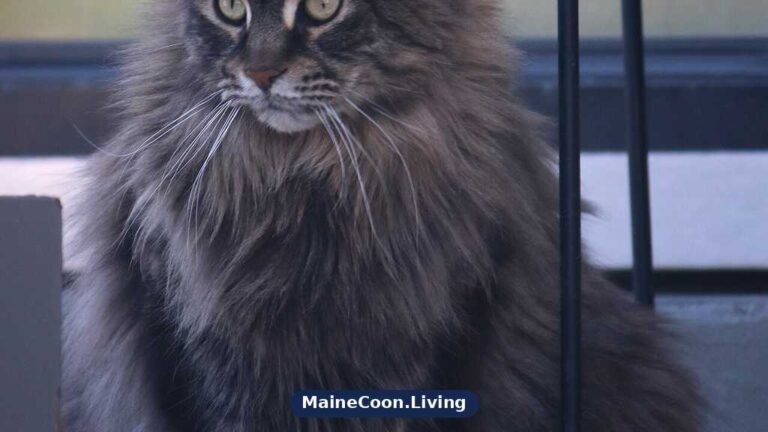
The first time I really noticed it, a delivery rider knocked after dark, well outside our usual routine. Before I had even stood up, my Maine Coon was already in the hallway, sitting square in front of the door, silent and staring at it.
He did not look brave, exactly. He looked like he had appointed himself to the job of checking first.
Owners swap stories like this all the time, and it is why the protective question comes up so often. The honest answer sits in the middle. A Maine Coon will watch over a household with real devotion, but the guarding is feline from start to finish.
The shadow in the hallway
Following from room to room is the behaviour owners mention most, and it starts young. Kitchen, desk, bathroom doorway, back to the kitchen again. It can feel like surveillance, and in a gentle way, that is close to what it is.
My cat does not need anything on most of these trips. He checks where I have landed, circles once, and settles within sight, often with his back to me and his face toward the room. That outward facing settle is the detail experienced owners recognise straight away.
It helps to compare it with the broader picture of Maine Coon temperament, because the following is not a separate guarding instinct. It is the same sociable, people focused nature, pointed at one job. The cat wants to be near its person, and being near means knowing what that person is doing.
Between you and the stranger
The second behaviour is positioning. A visitor arrives, and the cat quietly places itself between the guest and the family, on a chair arm, a rug edge, or flat in the middle of the floor. Nobody taught this.
It happens because the cat wants a clear view of the new person and a short path back to you.
Watch the body language and it stays relaxed more often than people expect. Ears stay forward, the tail stays low and still, and after a few minutes the cat usually sniffs a shoe and downgrades the visitor to furniture.
The assessment is the guarding. Once the assessment passes, the shift is over.
Problems start when owners misread this and push the introduction. Forcing a big cat to be stroked by a stranger it is still studying teaches it that visitors mean stress. Let it watch from its chosen spot, and most Maine Coons come forward in their own time, because curiosity beats caution in this breed.
Door watching and sound checks
Maine Coons learn the soundtrack of a house with embarrassing accuracy. They know the gate, the usual cars, the neighbours, and the hour the house normally goes quiet. Anything outside that pattern earns a lifted head, a still body, and sometimes a low chirp of inquiry.
Those chirps and trills are part of the alert system, which is why our guide to why Maine Coons chirp and trill is worth reading alongside this one. A short trill at a window bird is play talk. A repeated, fixed stare at the same door, with the body held low, is your cat telling you something out there does not match the routine.
I have learned to go and look when I get that second version. Usually it is a cat on the fence or a bin lid in the wind. Once, it was a parcel left in the rain that I would have missed until morning.
The alarm is not always important, but it is rarely random.
Checking on the children
Ask parents and you will hear the cot stories. A Maine Coon hears the baby stir and arrives before the monitor has fully woken anyone. Others park themselves in a child’s doorway at bedtime, or do a slow round of bedrooms last thing at night, looking into each one.
I am careful about how I describe this, because it is easy to inflate. The cat is probably responding to sound, routine, and a small person it has accepted as part of its group. Small children also drop food, which does nothing to reduce a cat’s interest in visiting them.
Still, the pattern is consistent enough that owners trust it as information. A cat that normally does the bedtime round and suddenly will not enter a child’s room is telling you something changed in there. New furniture, a strange smell, or a visiting pet can all explain it, but the cat noticed first.
What attachment research shows
For years, cats carried a reputation for indifference that the research never quite supported. A widely reported 2019 study at Oregon State University put cats and kittens through a secure base test, the same kind used with infants and dogs. The animals spent time in an unfamiliar room with their owner, were left alone briefly, and were then reunited.
Around 65 percent of the cats were classed as securely attached, a figure close to the one seen in human infants. Securely attached cats greeted their owner, calmed down, and went back to exploring. Insecurely attached cats either clung and stayed stressed, or avoided the owner altogether.
That study explains the hallway shadow better than any guarding instinct does. A cat that uses you as its secure base keeps track of where you are, because your presence is how it judges whether a room is safe. The ASPCA guide to fear in cats makes a useful companion read here, since it shows how the same closeness can tip into fear when a cat feels unsafe.
Attachment also explains why the bond looks one sided in some homes. Many Maine Coons pick a favourite person, often the one who feeds, plays, and keeps the routine. Other family members get affection, but the following, the door watching, and the night checks are usually reserved for that one secure base.
The honest limits
Here is the part to say without any decoration. A Maine Coon is not a guard dog, and it will not defend your home. There will be no barking at the fence, no holding ground against an intruder, and no protection in any situation where a person means harm.
Size fools people on this point. A large male looks imposing on a doorstep, and an unfamiliar visitor may hesitate, but that is the visitor’s reaction, not the cat’s plan. Faced with a genuinely frightening event, a sensible cat runs, hides, or freezes, and a Maine Coon is a sensible cat.
Noise is another limit. Most Maine Coons will not raise a sustained alarm the way a dog does. You may get a growl, a hiss, or a burst of unusual vocalising, and then silence while the cat watches.
If home security is a real concern, you need locks, lights, and probably a dog, not a cat with a good stare.
There is also a limit on the other side. A cat that follows you is not automatically coping well with being left, which is why we covered how long Maine Coons can be left alone in a separate guide. Loyalty and separation stress can live in the same cat, and owners do better when they plan for both.
Protective, anxious, or guarding?
Three different behaviours get bundled under the word protective, and separating them matters. The first is the relaxed watchfulness described above. The cat notices, assesses, and then lets it go, returning to a nap or a meal without a backward look.
When it is anxiety instead
An anxious cat cannot complete that cycle. The trigger passes, but the tension stays, showing up as hiding, flattened ears, a twitching tail, over grooming, or a cat that startles at ordinary sounds for the rest of the evening.
That is not devotion turned up louder. It is a cat that does not feel safe in its own house.
Anxiety also drives the clingy version of following, where the cat cannot settle unless it is touching you and panics when a door closes between you. Owners often feel flattered by it at first. Living with it is harder, for the cat most of all, and it deserves help rather than praise.
When it is resource guarding
Resource guarding looks different again. The cat is not protecting you, it is protecting access to something it values, usually food, a resting spot, a toy, or sometimes your lap. The signs are specific: stiffening over the bowl, growling when approached mid meal, or blocking another pet from a favourite place.
This is also where households with other animals need to be honest. A cat that guards can make life tense for a dog or a second cat, even while it stays sweet with people. Our notes on Maine Coons living with dogs cover the slow introductions that prevent most of these stand offs.
Guarding that appears suddenly, or guarding paired with appetite changes, is not a training problem to argue with. It is information about pain, stress, or a household change that has unsettled the cat. Treat the cause and the behaviour usually softens with it.
When a change means the vet
Every long term owner learns their cat’s normal level of watchfulness, and that baseline is the real early warning system. What should worry you is not a protective cat. It is a cat whose pattern changes without an obvious reason.
A cat that becomes unusually clingy, unusually distant, newly aggressive at the door, or suddenly guardy over food may be dealing with pain or illness. Cats hide discomfort well, and behaviour is often the first place it leaks out. Our overview of common Maine Coon health problems is a sensible starting point before you assume it is attitude.
My rule is simple. If the new behaviour lasts more than a few days, or it arrives with eating, drinking, litter, or sleep changes, the vet sees the cat before anyone tries behaviour fixes. Plenty of so called guarding problems have turned out to be sore teeth, sore joints, or a thyroid that needed attention.
Living with a cat on watch
The best response to a watchful Maine Coon is to make the watching easy. A perch near the front window, a bed in the room where you spend the evening, and a routine that does not change without warning all lower the cat’s workload. A cat that can see the door does not need to patrol for it.
Reward the calm version of the behaviour. When your cat checks a visitor and then relaxes, a quiet word or a treat tells it the assessment was enough. Never praise growling at guests, and never turn the door routine into a game, because a wound up big cat at the entrance helps nobody.
Then enjoy what is genuinely there. No, your Maine Coon will not save the house. But a cat that notices the rider at the gate, checks the children’s rooms at night, and sleeps facing the door of the room you are in is paying attention to your family in the only way a cat can.
For most of us who live with one, that turns out to be plenty.
Frequently Asked Questions
Do Maine Coon cats actually protect their owners?
They protect in a feline way, by watching, following, positioning themselves close, and making noise when something seems wrong. That early warning is real and useful. What they will not do is confront a threat the way a trained guard dog would.
Why does my Maine Coon follow me from room to room?
Following is usually attachment, not worry. Your cat has learned your routine, enjoys your company, and prefers to settle wherever you settle. It only becomes a concern if the following turns frantic, vocal, or paired with appetite or litter changes.
Will a Maine Coon protect my children?
Many Maine Coons check on children, sleep nearby, and come to look when a baby cries, because the sound is new and the child is part of the household. That is supervision, not babysitting. Adults still need to watch every interaction, especially while a child learns gentle handling.
How can I tell guarding from anxiety?
A watchful cat relaxes once the visitor is accepted or the noise stops, and normal life resumes. An anxious cat stays tense, hides, over grooms, or keeps reacting long after the trigger has gone. If the tense version becomes the pattern, talk to your vet about stress and pain.
Can I train my Maine Coon to guard the house?
No, and trying would work against the temperament you chose the breed for. You can reward calm watching and relaxed greetings so your cat feels confident around visitors. A confident cat is a better early warning system than a wound up one anyway.