Maine Coon Temperament: The Full Personality Picture
People usually notice the size first. Then they soon notice something else: this enormous cat is following me around the kitchen, talking in soft little chirps, and acting faintly offended that I have closed the bathroom door.
That contrast is the whole breed in miniature. Maine Coons look like they should be aloof, wild, maybe even a bit formidable, and instead they turn out to be steady, companionable cats who want to be included in whatever the household is doing.
Temperament is not one trait, though. It is a bundle of them, loyalty, curiosity, patience, playfulness and a surprising fondness for running water, and the pieces only make sense together.
The Gentle Giant Baseline
The baseline mood in my house is calm. My cat can be startled, bored or briefly put out, but she always returns to an unhurried, tolerant good humour.
That tolerance shows in small ways. She puts up with brushing, nail trims and visiting relatives with a patience that would flatter a much smaller and less powerful animal.
It also takes a lot to genuinely rile a Maine Coon. Raised voices, a dropped pan or a dog barking outside might earn a lifted head and a slow blink, not a panic or a swipe.
Which is exactly why real aggression deserves attention. In this breed, aggression is a symptom to investigate, not a character flaw, and a cat who suddenly hisses or bites is usually frightened, in pain or unwell, so the answer is a vet check rather than punishment.
Dog-Like Loyalty, on Their Terms
Owners reach for the dog comparison because the loyalty is real. My cat greets me at the door, follows the sound of my keys, and seems to keep a rough mental map of where everyone in the house is.
The shadowing is constant but polite. Cook dinner and she will supervise from the doorway, work at a desk and she will settle underneath it, move rooms and you will hear the soft pad of large paws arriving a moment later.
What most Maine Coons are not, despite the devotion, is true lap cats. A full grown cat of this size draped across your knees is an event, and many prefer to press against your leg, stretch along the sofa beside you, or claim the neighbouring cushion.
I have come to prefer it, honestly. Beside you is a choice she makes again every evening, and there is something quietly flattering about a cat who could sit anywhere in the house and keeps choosing the spot within reach of your hand.
The Voice: Chirps, Trills and Conversation
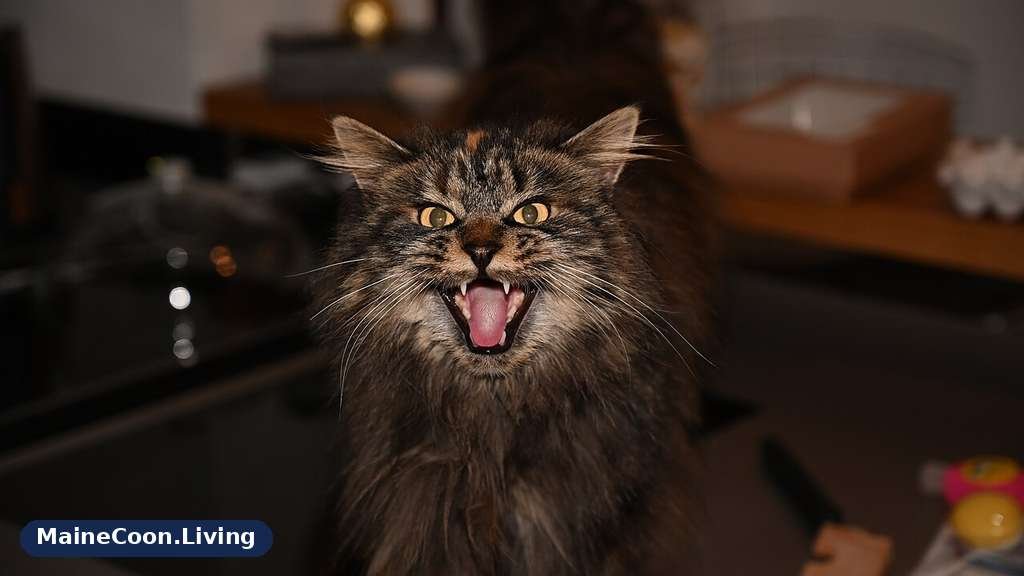
For such a big cat, the voice is startlingly small. Instead of the full throated meow people expect, Maine Coons mostly communicate in chirps, trills and soft chattering sounds that sit somewhere between a bird call and a question.
The trill is the everyday workhorse. It means hello, follow me, look at this, or simply that she has arrived in a room and would like that fact acknowledged by the people already in it.
Talk back and it becomes a conversation. I answer a chirp with a few words, she answers again, and we can trade sounds across a room in a call and response that neither of us seems willing to end first.
If you want the full translation, I have written separately about why Maine Coons chirp and trill and what each sound tends to mean. Once you can read the sounds, the cat feels far less mysterious and far more chatty.
A Curious Relationship With Water
Most cats treat water as an insult. Mine treats it as entertainment, and she is fairly typical of the breed, which surprises guests who find her perched on the sink edge like a small lifeguard.
Expect paws in water bowls, fascination with dripping taps, and close supervision of showers and baths. Some Maine Coons will pat at a stream of water for minutes, shake droplets everywhere, and then look thoroughly pleased with the whole experiment.
The usual explanation is heritage. These were working farm cats in a cold, wet corner of New England, and a thick, water resistant coat would have served them well outdoors.
A drinking fountain is the easiest way to channel it. It gives the fascination a proper outlet, encourages drinking, and saves your taps from becoming an on demand toy operated by a very persistent cat.
Brains: Intelligent, Trainable and Easily Bored
Maine Coons are properly intelligent, not just food motivated and lucky. Mine worked out how a door handle moved within weeks of arriving, remembers exactly which cupboard holds the treats.
That intelligence makes them unusually trainable for a cat. Many learn to fetch, and plenty take to harness walks, puzzle feeders and simple clicker training with real enthusiasm.
Start small and keep sessions short. A few minutes of clicker work, a reward when she comes to her name, a fetch game she already loves, and you are building on what this breed naturally enjoys rather than fighting its nature.
The catch is boredom. An under stimulated Maine Coon rarely becomes dramatic, but she will invent jobs for herself, opening cupboards, relocating small objects, and waking you at dawn to suggest a better schedule.
Playfulness That Never Fully Retires
Maine Coons mature slowly, and the kittenish side lingers well into adulthood. Play arrives in cheerful bursts, a sudden gallop down the hallway, an ambush on a feather wand, and then a very long nap.
Those zoomies between naps can confuse people who expect calm to mean sedate. It does not, because with this breed calm means gentle, paws stay fairly soft even in play, games stay social, and the cat usually checks that you are enjoying it too.
Keep the toys varied and put some away between sessions. Rotation keeps old toys interesting, and a short play session before bed is still the most reliable way I know to spend that evening energy in the right place.
Social, But Not Needy: The Independence Balance
The balance is one of the breed’s best features. A Maine Coon wants company and involvement, yet a healthy adult is rarely frantic or clingy, and can amuse herself while you get on with your day.
That said, independent is not the same as solitary. These cats bond closely, notice absences, and do best in homes where someone is around for a good part of the day, or where another pet provides company.
If your work keeps you out for long stretches, my guide to how long Maine Coons can be left alone covers enrichment, routines and the point where a second pet or a sitter starts to make sense. Plan honestly for the social needs, and most working households manage fine.
With People, Children and Other Animals
With people, the pattern is friendly without being pushy. Most Maine Coons welcome visitors, supervise children calmly, and suit family life well, provided children learn gentle handling and to let a resting cat rest.
Other animals are usually an easy fit too. Given slow introductions, most live peacefully with other cats and with cat friendly dogs, and my notes on Maine Coons living with dogs explain how those first meetings should go.
No Two Are Quite the Same
Breed temperament is a tendency, not a guarantee stamped on every kitten. I have met bold Maine Coons who greet strangers at the door and shy ones who observe visitors from the stairs for an hour before deciding anything.
Sex plays a smaller part than people expect. Males are often described as goofier and females as a touch more reserved and dignified, but the overlap between individuals is far bigger than the difference.
Early socialisation and genetics matter much more. A kitten raised underfoot in a busy home, handled gently by different people, usually grows into a steadier adult than one raised in quiet isolation, whatever its sex or colour.
Even littermates diverge. Two kittens from the same litter, raised in the same house, can grow into one shadow cat and one independent thinker, which is worth remembering before you promise yourself an exact personality.
Myths Worth Retiring
The raccoon story is the oldest myth of all. Maine Coons are not part raccoon and cannot be, and the name almost certainly comes from Maine and a ringed, bushy tail that reminded people of one.
Nor are they wild or dangerous under the domestic surface. The size, ear tufts and serious expression fool strangers, but owner experience consistently puts this among the gentler and more tolerant breeds to live with.
They are not silent, either, as anyone woken by a dawn trill can confirm. The bigger commitment is emotional, though, because a cat this social genuinely minds being ignored.
Shaping the Temperament You Live With
You inherit a temperament, then you shape it daily. Kittens need early, gentle exposure to household sounds, visitors, handling and short car trips, because experiences in the first weeks echo through the adult cat’s confidence for years.
Positive reinforcement does nearly all the useful work after that. Reward the behaviour you want with food, play or attention, redirect the behaviour you do not, and skip punishment entirely, since it teaches a Maine Coon to avoid you rather than to understand anything.
Routine helps more than people expect. Predictable feeding, play and quiet times make the world legible to a cat, and the ASPCA guidance on general cat care makes the same point about consistency, gentle handling and watching for changes in behaviour that might signal a health problem.
Get those basics right and the breed more or less raises itself. What you end up with is a calm, funny, talkative companion who has quietly reorganised the household around being near you.
Frequently Asked Questions
Are Maine Coons lap cats?
Some are, but most are beside you cats rather than on you cats. Expect a large cat pressed against your leg or stretched along the sofa next to you.
Do Maine Coons meow a lot?
They talk a lot, but rarely loudly. Most of the conversation is chirps, trills and soft chatter rather than full meowing, which makes them vocal company without being noisy neighbours.
Are Maine Coons aggressive because of their size?
No, the size misleads people. Maine Coons are among the calmer and more tolerant breeds, and genuine aggression is rare, usually pointing to pain, fear or illness that needs a vet.
Can a Maine Coon cope while I am at work?
Yes, most cope well with a normal working day if the home is enriched. They are social cats, though, so long daily absences call for toys, routine, and possibly another pet for company.
Why does my Maine Coon follow me everywhere?
Because that is the breed working as designed. Maine Coons bond closely, stay curious about household activity, and simply prefer being near their people to being alone in another room.

7 Comments