Maine Coon body language: tail, ears and chirps decoded
Living with a Maine Coon has taught me that this breed is always talking, and I am Umar, so I have had years of practice listening.
Mine narrates the whole day with tail lifts, ear flicks, chirps at birds, and long slow blinks from across the sofa.
The trick is that no single signal means one fixed thing on its own. You read the tail, the ears, the eyes, and the whole body together, and you read them in context.
This guide decodes Maine Coon body language signal by signal, the way I have learned it at home. Once you know the basics, daily life gets calmer for both of you, because you stop guessing and start responding to what your cat actually said.
Start with the tail
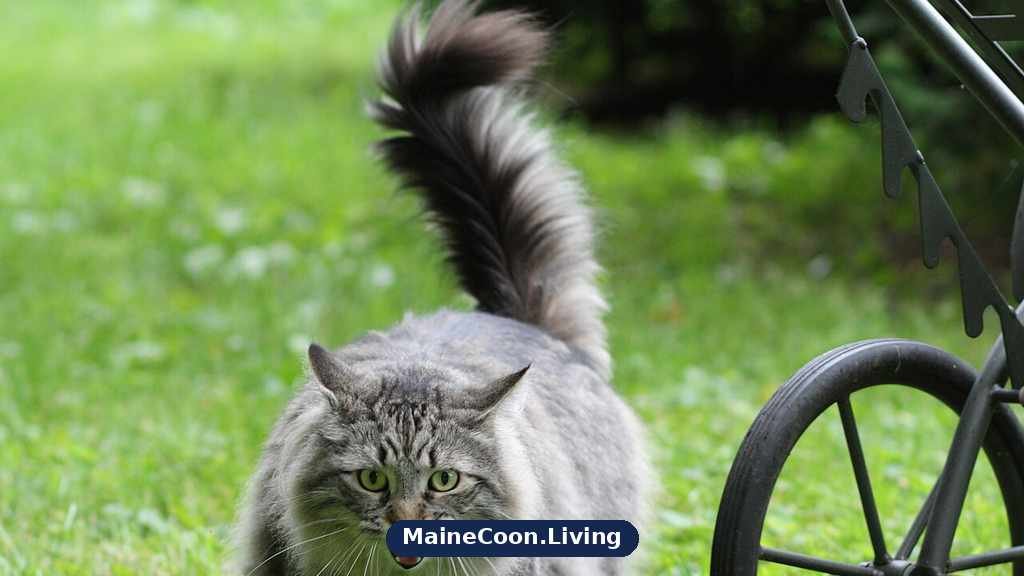
The tail is the clearest place to start, and on a Maine Coon it is hard to miss. That long, plumed tail works like a flag, and its height and movement change the meaning completely.
International Cat Care makes the same point in its guide to cat communication, where the upright tail is described as a friendly signal on approach. My experience at home matches that exactly.
Tail straight up
A tail held straight up as your cat walks towards you is a confident, friendly greeting. It is the clearest you are welcome here signal a Maine Coon gives.
My cat does this at the front door and again around food time. I answer by crouching down, letting him rub against my hand, and keeping my voice low and relaxed.
The question mark curve
Sometimes the upright tail bends at the tip into a soft curve, a bit like a question mark. That little hook usually adds playfulness to the greeting.
It is a good moment to offer a wand toy or a short game. Most Maine Coons in this mood are social, curious, and ready to interact on friendly terms.
Puffed up tail
A tail that suddenly doubles in size has a very different message. The fur stands out to make the cat look bigger, and that happens when a cat feels startled, threatened, or cornered.
You may also see an arched back and a sideways stance. Do not reach in to comfort a cat in this state, because a frightened cat can scratch or bite without meaning to be unkind.
Give space, remove the trigger if you can, and let the fur settle on its own. The puff usually fades within minutes once the cat feels safe again.
Low swish and tail lashing
Movement matters as much as height. A slow sway while your cat watches something can simply mean focus, especially during play or bird watching from a windowsill.
A fast, hard lash from side to side is a warning that arousal is climbing. During petting, that lashing tail often arrives before a nip, so it is your cue to stop your hand and pause.
Tucked tail
A tail tucked low or curled tight against the body points to anxiety or insecurity. The cat is trying to look smaller and less noticeable.
At home this might appear with visitors, loud building work, or a new pet in the house. Keep routines steady, offer hiding places, and let your cat choose when to come out.
Tail wrapped around
A relaxed tail wrapped loosely around the body while resting is usually a sign of calm contentment. It is the resting position of a cat who feels no need to signal anything urgent.
Maine Coons also wrap that big tail around a person or another cat they like. When mine curls his tail around my ankle in the kitchen, I read it as simple companionship.
Reading kittens differently
Kittens exaggerate every signal in this guide, and that is normal. A kitten pounce with puffed fur and sideways hops is usually play, not fear, and a kitten who flops over during a game is inviting more play, not showing the same trust display an adult shows. The signals settle as the cat grows, so judge a kitten by the pattern over days, not by one dramatic moment.
The other difference is speed. Kittens switch from relaxed to wired and back again in seconds, which means the tail you read a moment ago may already be out of date. Watch the whole sequence rather than one snapshot. Our guide to Maine Coon kitten development covers the weeks when these signals first appear and start to settle.
What the ears are saying
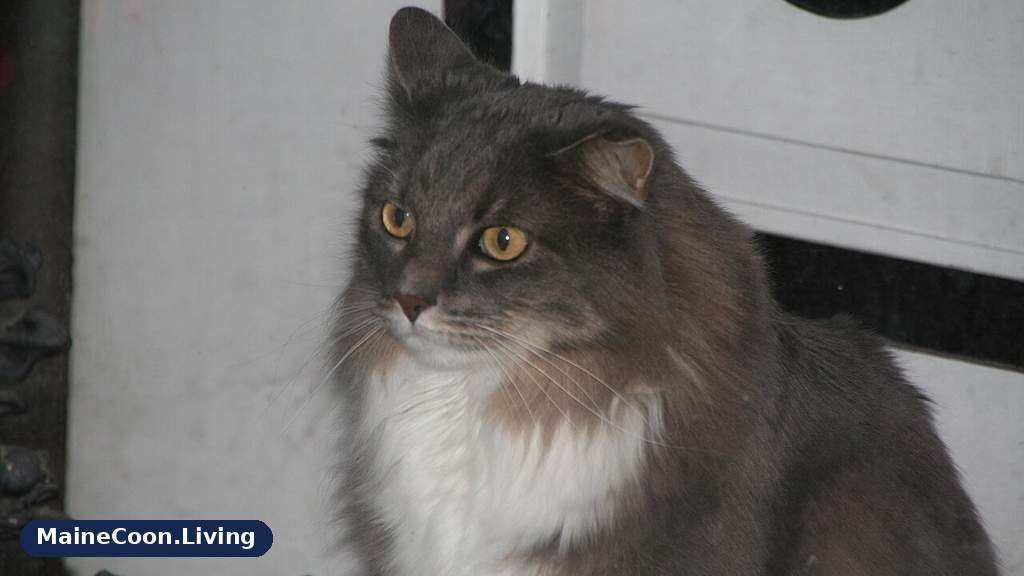
Ears change position in a split second, so they are brilliant early warnings. On a Maine Coon, the ear tufts make those movements even easier to spot once you start looking.
Ears forward
Ears facing forward in their natural position mean interest and relaxation. Your cat is paying attention, but there is no tension in the signal.
This is the ear position you want to see during play, training with treats, or a quiet stroke on the sofa. Forward ears plus a loose body is a settled cat.
Sideways aeroplane ears
When ears rotate out to the sides, owners often call them aeroplane ears. That sideways turn usually means uncertainty, mild irritation, or a cat who is working out what happens next.
I see this at the vet waiting room and when a strange noise comes from outside. It is not a crisis, but it is a prompt to slow down and watch the rest of the body.
Ears flat back
Ears pressed flat against the head are a clear distance signal. A cat doing this feels defensive, frightened, or angry, and wants the pressure to stop.
Flat ears with a crouched body and wide eyes mean you should step back right away. Continuing to approach or pick the cat up in this moment risks a scratch and damages trust.
Swivelling ears are different again. A cat rotating each ear like a small satellite dish is simply listening hard, tracking sounds you may not even have noticed.
Eyes and the slow blink
Cat eyes speak in blinks and in pupil size. A soft gaze with half closed lids is one of the warmest signals in the whole Maine Coon repertoire.
The slow blink is my favourite piece of body language to return. When my cat looks at me and closes his eyes slowly, I do the same back, and the whole mood of the room softens.
Researchers and welfare groups describe slow blinking as a positive, non threatening signal between cats and people. You do not need to stare or lean in, just soften your gaze, blink slowly, and look slightly away.
A hard, unbroken stare is the opposite message. Between cats it can be a challenge, and from a person it can feel intense, which is why cats often approach the guest who politely ignores them.
Pupils need context, because they change with light as well as feeling. Wide pupils in a dim room during play are normal, while wide pupils with flat ears and a tense body in bright light point to fear or overstimulation.
Narrow pupils can mean relaxed focus in bright light, or irritation if the body is stiff and the tail is lashing. Never judge pupils alone, always pair them with ears, tail, and posture.
The whole cat test in ten seconds
When you are unsure what your cat is saying, run a quick check from tail to ears. Tail height and movement, ear position, eye softness, whisker direction and body looseness together give you an answer in about ten seconds. Any two signals pointing the same way is usually enough to act on, and three pointing the same way is a clear message.
Practise the check when your cat is calm, so you know what his normal looks like before you need it. A relaxed Maine Coon has a loose body, soft eyes and ears in their natural forward position, and that baseline is the picture every other signal is measured against. Our guide to Maine Coon temperament describes that settled baseline in more detail.
The belly up truth
Few signals get misread more often than the exposed belly. A Maine Coon flopped on its back, paws curled and tummy on show, looks like an open invitation to tickle it.
Most of the time, it is not an invitation at all. Rolling over is mainly a trust display, a way of saying your cat feels safe enough to show its most vulnerable area near you.
Some cats do enjoy a brief belly rub, and you will know yours by its reaction over time. If the body stays loose and the cat leans in, a short rub may be welcome.
If the paws grab your hand, the tail starts to thump, or the ears turn sideways, stop at once. Those are polite warnings, and respecting them is exactly how you keep the trust that produced the roll in the first place.
I stick to cheeks, chin, and the top of the head for most greetings. Those areas carry scent glands and most Maine Coons actively push into a rub there.
Chirps, trills and meows
Sound is body language too, and Maine Coons are famously vocal for a large breed. Their voices are surprisingly soft, and the small sounds carry most of the meaning.
I explain the greeting sounds in more depth in my guide to why Maine Coons chirp and trill, because those two sounds deserve a guide of their own. Here is the short decoder I use every day.
Chirps
A chirp is a short, bright sound often made with the mouth almost closed. My cat chirps at birds through the window and sometimes at a toy he wants me to throw.
In that window watching context, chirping often comes with a fixed gaze, forward ears, and a flicking tail tip. It looks like excitement and frustration mixed together, the hunter who can see the prey but cannot reach it.
Trills
A trill is a rolling, closed mouth greeting that rises at the end. Mother cats use it with kittens, and many Maine Coons keep using it with their favourite people for life.
At home, a trill usually means hello, follow me, or I am pleased you are here. Mine trills when he leads me to his food bowl, his brush, or simply to the sunny spot he has chosen.
Meows
Meows are mostly a people directed sound in adult cats. Maine Coons tend to meow less loudly than people expect, and they often save the sound for a specific request.
Read the meow with the body that comes with it. A meow with tail up and a rub against your legs is a social request, while repeated meowing with pacing and hiding can mean discomfort.
Growls, hisses, and spits sit at the far end of the scale and should never be punished. They are clear warnings, and a cat who is allowed to warn is a cat who rarely needs to escalate.
Kneading, bunting and the quiet signals
Not every signal is loud. Kneading with the front paws is a leftover from kittenhood, when kittens knead to help milk flow, and most adult cats do it when they feel safe and content. Head bunting works the same way, because a cat rubbing his head on you is marking you with scent from glands on the cheeks and forehead.
Slow blinks, a tail wrapped around your ankle, and a cat who chooses to sleep near you rather than on you are all quiet versions of the same message. They mean your cat feels safe in your company. Our guide to why Maine Coons chirp and trill covers the sounds that go with these quiet signals.
Whiskers and pupils together
Whiskers are easy to overlook, but they frame the face and shift with mood. On a Maine Coon they are long and dramatic, which makes the changes easier to learn.
Relaxed whiskers point out to the sides in a loose fan. Your cat is calm, unhurried, and not trying to judge a threat.
Whiskers pushed forward can mean curiosity, excitement, or hunting focus. Paired with forward ears and a still body, that forward fan often appears just before a pounce on a toy.
Whiskers pulled back flat against the cheeks suggest the cat wants to look smaller or feels defensive. With aeroplane ears and a low body, that combination is a strong sign to give space and time.
Put whiskers and pupils together and the picture sharpens. Forward whiskers, wide pupils, and a crouched, twitching body is an excited hunter, while flat whiskers, wide pupils, and a tucked tail is a worried cat who needs the situation to ease.
Whole body stress signals
Sometimes the message is not in one body part but in the whole cat. Learning these full body patterns is what turns casual watching into real understanding.
This side of the breed is part of the gentle, social character described in my guide to Maine Coon temperament. A confident Maine Coon moves loosely, explores openly, and recovers quickly from small surprises.
Hiding more than usual
All cats hide, and Maine Coons love a box or a wardrobe as much as any breed. The warning sign is a change, such as a social cat who suddenly spends the whole day under the bed.
New hiding can follow a house move, visitors, building noise, or conflict with another pet. It can also be an early sign of pain, so do not dismiss a sudden change as mere moodiness.
Crouching low
A cat crouched low with weight shifted back is ready to flee. The head may be tucked in, the eyes wide, and the tail wrapped tight around the body.
Let that cat leave the situation rather than following for a cuddle. Chasing a crouching cat confirms its fear and makes the next encounter harder.
Freezing and sudden stillness
A cat who goes completely still during petting is not always relaxing. Stillness with a tense body, turning head, and skin twitching along the back often means the touch has become too much.
This is the moment I lift my hand away and wait. If my cat wants more, he will push back into my hand, and that choice keeps petting pleasant for both of us.
Other stress clues include appetite change, grooming far more or far less than usual, and using the litter tray differently. One clue alone may mean little, but a cluster of changes over several days deserves attention.
When play tips into overstimulation
Play is the moment most owners misread, because a cat who was enjoying a game can tip into overstimulation in seconds. The signs are a tail that starts lashing, ears turning sideways, skin rippling along the back, and a sudden stillness that is not relaxation. That stillness is the warning, and the next step is usually a nip.
End the game the moment you see that cluster, not after the nip. Put the toy down, step back, and let your cat settle on his own terms. A short break keeps play fun tomorrow, while pushing through teaches your cat that hands are something to attack. Our notes on whether Maine Coons are friendly describe the sociable baseline this behaviour is measured against.
If you are wondering how this fits the breed reputation, my notes on whether Maine Coons are friendly cover how sociable these cats usually are. That baseline is useful, because stress stands out most clearly against what is normal for your own cat.
When behaviour change means a vet visit
Cats hide pain well, so behaviour is often the first symptom an owner can actually see. A vet visit is warranted when the change is sudden, strong, or lasts more than a day or two.
Book promptly if your Maine Coon stops eating, hides and will not come out, cries when picked up, or becomes aggressive in a way that is new. The same applies to limping, breathing changes, repeated vomiting, or trouble using the litter tray.
Take a short video of the behaviour if you can do so without stressing your cat further. A thirty second clip of a crouch, a limp, or a tail posture helps your vet far more than a long description from memory.
I am an owner, not a vet, and this guide is about reading signals, not diagnosing causes. The signals simply tell you when it is time to get professional eyes on your cat.
Putting the whole picture together
The real skill is combining signals rather than memorising a list. Tail up, ears forward, soft eyes, and a trill at the door is a complete happy sentence.
Flat ears, tucked tail, hidden body, and silence from a normally chatty cat is a complete sentence too, and it says leave me alone and check on me later. Both messages are easy once you read the whole cat.
Start by watching without touching for a week. Notice the greeting at the door, the ear position during petting, and the sounds around food and play, and you will learn your own cat dialect faster than any guide can teach it.
That is the quiet pleasure of living with a Maine Coon. The breed talks all day in small, honest signals, and once you can read them, the bond feels less like guesswork and more like a conversation.
Frequently Asked Questions
What does it mean when a Maine Coon holds its tail straight up?
It is a friendly greeting and a sign your cat is pleased to see you and open to interaction. Let your cat come to you, offer a hand to sniff, and keep the welcome calm. If the rest of the body is loose, you are looking at a content cat.
Is a swishing tail a happy sign in a Maine Coon?
Usually not. A slow, focused swish while watching a bird or a toy can mean concentration, but a fast lashing tail means arousal is rising and patience is running out. Stop petting, give space, and let the tail settle before you try again.
What does a slow blink from my Maine Coon mean?
A slow blink is a calm, trusting signal, a bit like a relaxed smile between cats. You can answer with your own slow blink, then look slightly away. Many Maine Coons will blink back or come closer after that exchange.
Should I rub the belly when my Maine Coon rolls over?
Not automatically. Rolling over often shows trust and relaxation, but the belly is a vulnerable area and many cats dislike it being touched. Try a brief chin or cheek rub instead, and only touch the belly if your own cat clearly leans in and stays loose.
When should a change in body language mean a vet visit?
Book a visit if a normally social cat suddenly hides for a day or more, stops eating, crouches in pain, or shows new aggression when touched. Sudden behaviour change is often the first visible sign of pain or illness in cats. Trust the change you can see, even if you cannot name the cause.