Why Do Maine Coons Chirp and Trill? A Sound Guide From Home
The sound that made me stop and listen came from the hallway, not the kitchen. I had just put my keys down, and from somewhere near the stairs came a bright, rolling brrrp, followed by a second one when I did not answer fast enough.
No bird had got into the house. It was my Maine Coon, trotting towards me with his tail up, announcing my arrival like I was the interesting event of his afternoon.
I am Umar, and living with this breed has taught me that the noise is half the relationship. If you have ever typed why do Maine Coons chirp and trill into a search box at midnight, you already know the puzzle.
A very large cat opens his mouth and out comes something small, musical, and completely unlike the meow you grew up expecting. This guide is my attempt to translate that soundtrack honestly, sound by sound.
Why these cats sound so different
Maine Coons are social cats who spend a lot of time near their people, following, watching, and joining in. Sound is simply part of how they stay involved, and you can see the same people focused streak running through the whole Maine Coon temperament.
Most of their everyday noises are made with the mouth mostly closed. That one detail explains a lot, because a closed mouth call cannot become a big open meow, so it comes out as a hum, a roll, or a burst instead.
International Cat Care describes cat communication in useful groups, with murmuring sounds made with a closed mouth covering greetings, acknowledgement, and approval. Trills and chirrups sit right in that friendly group, which matches daily life with this breed remarkably well.
Adult cats of any breed do most of their meowing at people rather than at each other. Maine Coons seem to have kept the kittenish contact calls and built their adult style around them, instead of leaning on the plain meow.
What a chirp actually sounds like
A chirp is short. It lasts a fraction of a second, starts high, and often rises a little at the end, a bit like someone quickly saying brrt or chirrup through closed lips.
Sometimes it comes once, a single bright note. Sometimes you get a neat row of them, chirp, chirp, chirp, while the cat walks and looks back at you between each one.
Chirps aimed at you
At home, chirps aimed at a person usually mean excitement that has found a target. The treat tub coming down from a shelf, a favourite wand toy appearing, or you sitting down in the chair where lap time usually happens can all earn one.
I read a chirp directed at me as an exclamation rather than a request. The request, if there is one, normally follows after, in the form of a meaningful stare at the cupboard.
Chirps at nothing obvious
Occasionally a chirp seems to happen at nothing at all, mid stretch or on the way across a room. In my experience that is commentary, the cat equivalent of talking while thinking, and it is one of the habits that makes the breed feel oddly companionable.
The trill, the everyday greeting
If the chirp is an exclamation, the trill is a sentence of welcome. It is longer, it rolls, and it wobbles up and down in pitch in a way owners usually write as mrrrp or prrrup.
The mouth stays shut or barely opens, so the sound vibrates rather than projects. Stand close and you can sometimes feel it as much as hear it, especially if a forehead lands against your shin at the same moment.
Trills turn up at reunions, at doorways, and on passing in narrow spaces where a polite noise seems required. My cat trills at the bathroom door most mornings, not to be let in, I think, but because meeting there has become our routine.
Where the trill comes from
Historically, this call belongs to mother cats and kittens. A mother uses chirrups and trills as contact calls, to gather kittens, call them out of a sleeping pile, and guide them along behind her.
Adult Maine Coons keep using that same family call with their humans. When your grown cat trills and then walks off looking over his shoulder, he is often doing exactly what a mother cat does, which is saying follow me and stay close.
That is why so many trills end at a food bowl, a closed door, or an empty water dish. The greeting and the guided tour are the same sound used twice.
Chirping and chattering at birds through glass
The window performance is a different production altogether. The cat locks onto a pigeon or a sparrow, the body goes still, the tail tip starts to flick, and then the jaw begins to work.
What comes out is a rapid clicking or stuttering, often written as kek kek kek, mixed in with short chirps. The teeth chatter, the whiskers push forward, and the whole cat vibrates with a hunt he is not allowed to finish.
Owners call this chattering, and it is closely tied to the chirp. Think of the chirp as excitement with the mouth closed, and the chatter as excitement that has reached the jaw.
Listen to a few Maine Coons in that video and you will hear how much the window sounds vary. Some cats stay almost silent apart from the jaw clicks, while others add squeaks and chirps until it sounds like a small argument with the glass.
Nobody knows for certain why cats chatter, and I am wary of anyone who claims they do. Frustration at unreachable prey is the common explanation, and some behaviour writers link the jaw movement to the quick bite a cat uses on prey, rehearsed without a target.
What I can say from watching it weekly is that it ends the second the bird leaves. The cat blinks, gives himself a shake, and wanders off entirely unbothered, which makes the frustration theory feel only half true.
How this differs from an ordinary meow
A standard meow starts with the mouth open and closes it as the sound runs, which gives it that familiar two part shape. It is flexible, and cats bend it into greetings, demands, complaints, and late night opinions.
Maine Coons can do all of that. The difference is proportion, because the meow is not their default tool, it is the backup they reach for when the softer sounds have failed to move you.
When mine does meow properly, it still surprises visitors. The voice is higher and lighter than the cat looks like it should own, a bit like hearing a lorry driver speak in a gentle falsetto.
Volume is misleading with this breed. A quiet trill can be a serious announcement, and a loud meow at the back door may mean nothing more dramatic than outrage that the door exists.
Context does the translating. The same short call means one thing beside an empty bowl at feeding time and something else entirely beside a sleeping dog he wants moved.
Trills as conversation
The habit people fall in love with is the reply. You say something ordinary, the cat answers with a trill, you answer the trill, and suddenly two adults are late for dinner because a conversation with a cat ran long.
This is not imagination, or not entirely. Cats learn quickly which sounds earn a response, and a cat whose trills always get an answer will trill more, aim it better, and time it beautifully.
Over months, the exchange sharpens. Mine has a short trill for passing in the hallway, a longer rising one for the top of the stairs, and a particular chirp trill blend that appears only when I open the drawer where the brush lives.
Talking back also tunes your ear without you noticing. Owners who chat daily with their cats spot a hoarse note, a strained call, or an unusual silence much earlier than owners who mostly hear background noise.
The rest of the repertoire
The warbling purr meow
Some Maine Coons layer purring under a meow, producing a warble that shakes in the middle. In our house this is the polite demand, used at laps, at closed bedroom doors, and whenever a human has sat down empty handed.
It is extremely effective, which is exactly why it survives. Cats repeat what works, and a sound that makes people smile while complying gets repeated a lot.
The silent meow
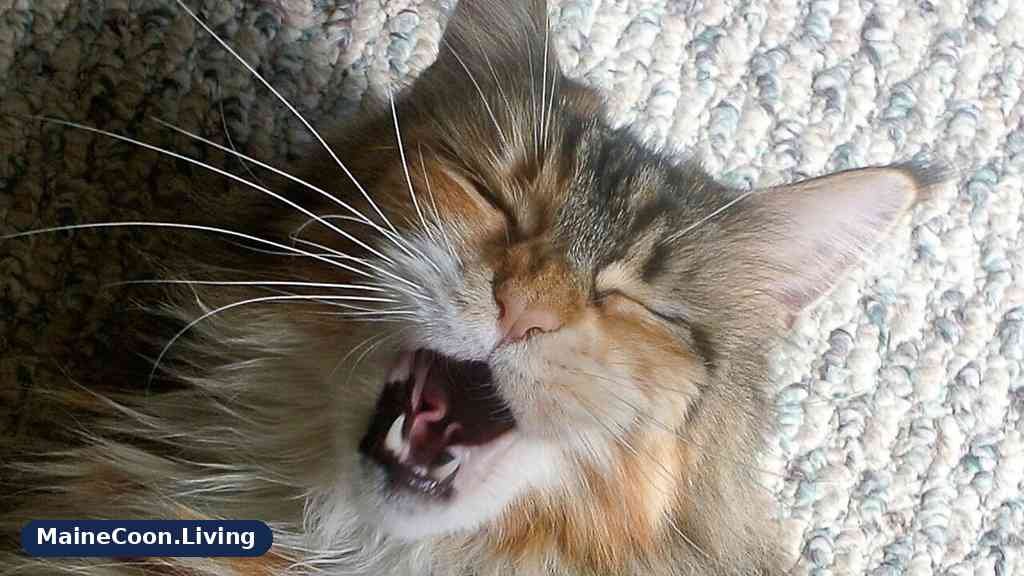
Then there is the performance with no soundtrack. The mouth opens wide, the face commits completely, and either nothing comes out or a tiny breathy squeak escapes at the end.
It tends to appear in soft moments, during chin scratches or half asleep contact. I treat it as a low effort meow from a cat too comfortable to fund the full version, and it has never once come with any sign of trouble here.
Short mews and muttering
Between the headline sounds sit the mutters, little mews, huffs, and half finished calls cats make while moving, settling, or being picked up. These are easy to miss and worth learning, because changes usually show up in this everyday layer first.
Sounds that should worry you
Most of this soundtrack is personality. A few changes, though, deserve real attention, and this is the section I would want a new owner to read twice.
The rule I use at home is simple: a brand new sound, or a familiar sound in a new place, gets investigated. That single habit covers most of the worrying cases below without turning every odd noise into a panic.
Sudden yowling
A yowl is long, loud, and drawn out, nothing like a trill. An occasional yowl at a closed door or in a carrier is unremarkable, but repeated new yowling, especially at night and especially in an older cat, can point to pain, raised blood pressure, thyroid trouble, or confusion.
Senior cats deserve extra credit for this one. Night time calling in an ageing Maine Coon is a known pattern with cognitive change, and our notes on senior Maine Coon care cover what else tends to shift alongside it.
Crying in the litter box
Crying, calling, or straining in the litter box is never a wait and see sound. It can mean a painful urinary problem, constipation, or a blockage, and a blocked male cat can deteriorate frighteningly fast.
Treat litter box crying as same day vet business, and an emergency if no urine is being passed. The wider list in our guide to Maine Coon health problems will help you place it among other warning signs.
The chatty cat who goes quiet
Silence worries me more than noise in a cat I know well. A Maine Coon who trills every morning and then says nothing for two days is telling you something, even if he is still eating.
Pain, stress, a sore throat, and plain unhappiness after a routine change can all mute a talkative cat. Cats left unsettled by long absences can go quiet too, which is part of the picture in our piece on leaving Maine Coons alone.
I am not a vet, and this guide is owner experience, not diagnosis. What I can say is that vets would rather hear about a strange new yowl early than meet the problem behind it a month later, so make the call when your ear says something is off.
Learning your own cat’s vocabulary
No sound guide, including this one, can hand you a finished translation. What it can do is point your attention at the right moments, because your cat’s vocabulary is partly his own invention.
Start by noting pairings rather than sounds. Which call comes with the food bowl, which one belongs to the window, and which one only ever happens at your bedroom door at six in the morning.
Within a few weeks the pattern feels obvious, and you will catch yourself answering correctly before you have consciously thought about it. Guests will look baffled when you announce that the cat wants water, not food, based on a noise they barely heard.
Record the odd ones on your phone if you can. A short clip of a new or worrying sound is genuinely useful at the vet, far better than your best impression of it in a consulting room, which I have done and do not recommend.
Most of all, enjoy the strangeness of it. A huge, lion maned cat who greets you like a songbird is one of the great small absurdities of living with this breed, and the day the hallway goes quiet, you will miss every single brrrp.
Frequently Asked Questions
Why does my Maine Coon chirp at birds through the window?
That chirping is an excited hunting response to prey he can see but cannot reach. The sound often comes with a fixed stare, a twitching tail tip, and sometimes a clicking chatter from the jaw. It is normal behaviour, and many owners set up a feeder view simply to enjoy the commentary.
What does a Maine Coon trill mean?
A trill usually means a friendly hello. Cats use it when they walk into a room, pass you in the hallway, or want you to follow them somewhere. Mother cats historically used the same closed mouth call to gather and guide their kittens, and adults keep using it with people they trust.
Do Maine Coons meow normally at all?
Yes, they can meow, and some do it often, especially around food or closed doors. Most owners simply hear meows less often because chirps, trills, and warbles do the everyday jobs first. A meow from a Maine Coon tends to sound softer and higher than people expect from such a large cat.
Why has my chatty Maine Coon suddenly gone quiet?
A sudden silence in a normally talkative cat can point to stress, pain, or illness, particularly if eating, hiding, or litter habits have changed too. A house move, a new pet, or a disrupted routine can also quiet a cat for a while. If the quiet spell lasts more than a day or two, call your vet and describe the change.
When should a new sound mean a vet visit?
Book a vet visit for repeated yowling, crying or straining in the litter box, a hoarse voice that does not clear, or any sound paired with appetite or behaviour changes. Crying in the litter box needs prompt attention because a urinary blockage in a male cat is an emergency. Trust your ear, because you know the normal soundtrack better than anyone.