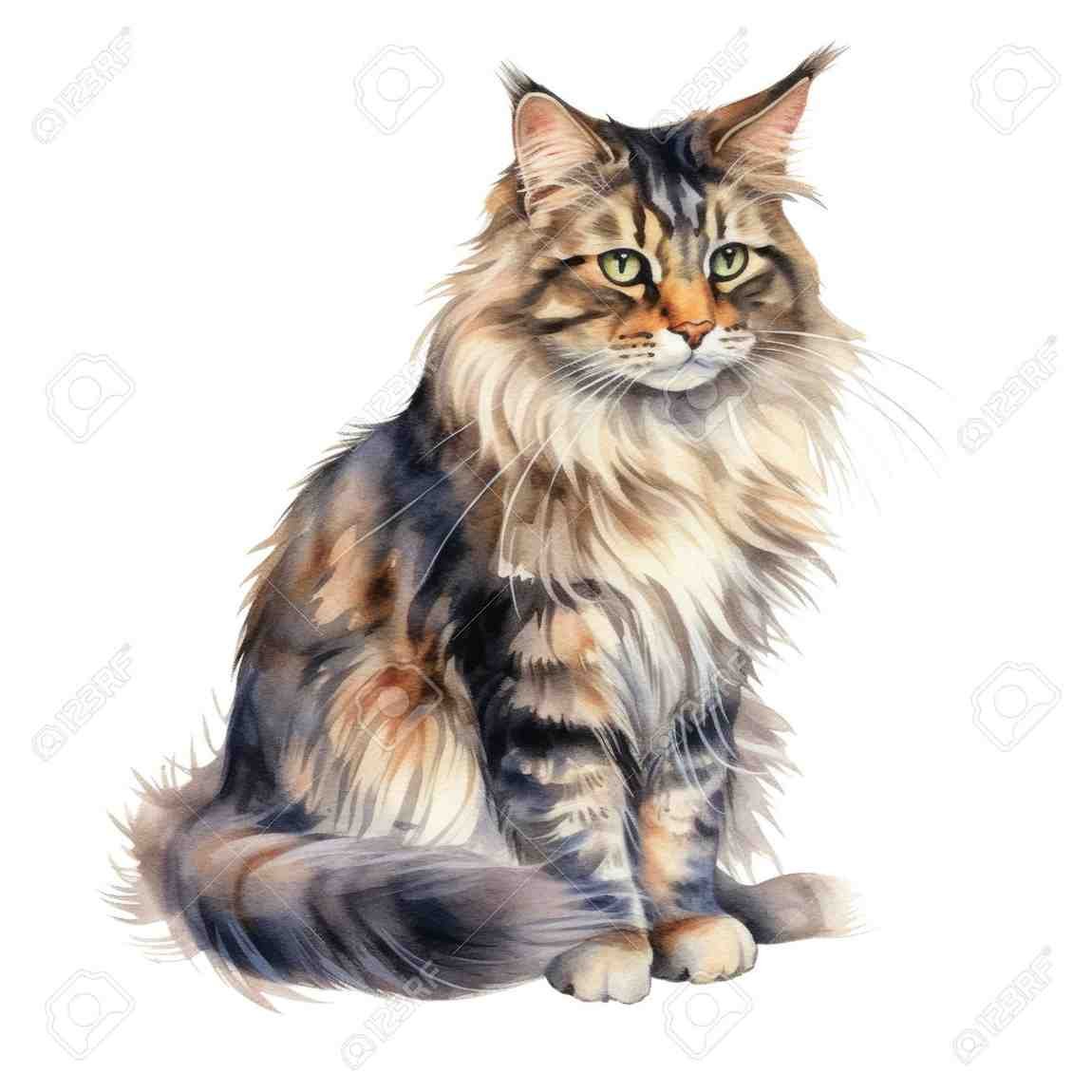
What Does a Maine Coon Cat Look Like? See the Traits
I am Umar, and I live with a Maine Coon who takes up more of the sofa than I do. When friends visit for the first time, the ears get the first comment. The tail usually gets the second.
People send me photos of big, fluffy cats all the time and ask whether theirs could be one. Sometimes I think yes, and sometimes I am looking at a very handsome domestic longhair who happens to be well fed. The difference lives in a handful of details, and once you know them, you cannot unsee them.
This is the full appearance checklist, the same set of points owners run through at home, vets note at a first checkup, and judges score in the show ring. We will go head to tail, feature by feature, so you can judge any cat against it.
Start With the Outline
Before you study any single feature, step back and look at the whole cat. A Maine Coon is built on a long, rectangular body, with a broad chest and a back that stays level from shoulders to hips. Nothing about the outline is round or tucked up.
The legs are medium to long, heavily boned, and set wide enough to hold that body well clear of the ground. This is the frame of a working farm cat from cold country, not a cat shaped for a parlour cushion.
Muscle matters as much as shape. Lift a healthy adult and you feel dense, solid weight rather than soft padding. Even the most laid back house cat carries that sturdy build under all the fur, and it is often the first thing people remark on when they pick mine up.
The Size Everyone Talks About
Size is the trait everyone knows, and it is real, but it is not the free for all the internet sometimes suggests. Most males I have met weigh between 13 and 18 pounds once fully grown. Females usually land between 8 and 12 pounds.
Height runs from about 10 to 16 inches at the shoulder. A long male, measured with his tail laid out behind him, can approach 40 inches from nose to tail tip. The record breaking giants in the news are the exception, and the everyday Maine Coon is simply a big, well proportioned cat.
Judges reward balance over raw bulk. A slightly smaller cat with the right proportions will place ahead of an oversized cat with a weak chin or a short tail. If you want the full picture on weights, heights and growth stages, I keep the numbers in my Maine Coon size guide.
The Head, Step by Step
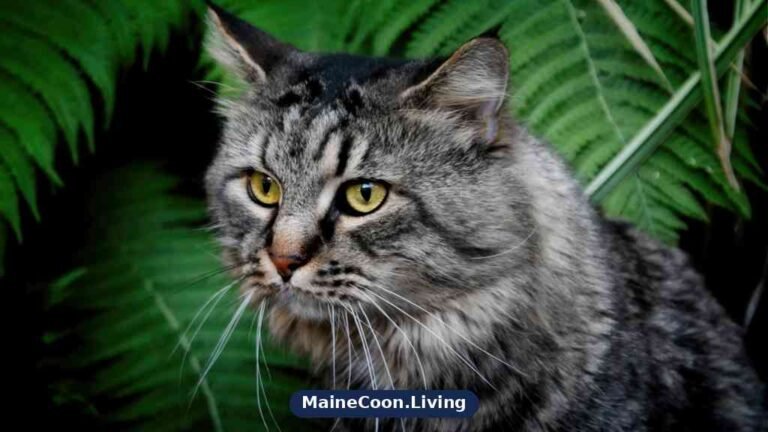
The head is where the breed really signs its name. Breed standards describe it as a modified wedge, medium in width and a touch longer than it is wide. In plain language, the face tapers gently from the ears down to the muzzle without ever looking pinched or narrow.
The cheekbones sit high and stay prominent, which gives the face its strong, slightly wild frame. From the side, the profile shows a gentle concave curve at the bridge of the nose. There is no sharp break, and nothing like the flat face of a Persian.
The Cat Fanciers’ Association breed standard puts a lot of weight on this head type, and for good reason. Get the head right and most of the rest of the cat tends to follow.
A Square Muzzle and a Strong Chin
If I could keep only one clue from this whole page, it would be the muzzle. On a Maine Coon it is visibly square, almost boxy, and it juts forward from the face instead of melting into it. Viewed from above, the muzzle looks like a small rectangle attached to the wedge of the head.
Underneath sits a firm, deep chin. In profile, the chin lines up with the tip of the nose and the upper lip, forming one clean vertical line. A weak or receding chin is one of the first faults a judge marks down, and it is just as useful a check for the rest of us.
Ears Tall Enough to Notice
The ears are large and tall, broad at the base, and set high on the head with a slight outward tilt. On a kitten they look almost too big, like satellite dishes the cat has yet to grow into. On an adult they balance the size of the head exactly.
Two details finish the picture. Lynx tips are the tufts of hair that grow past the pointed ear tip, and furnishings are the long hairs that fill the inside of the ear and spill out sideways. Not every Maine Coon grows dramatic lynx tips, but the heavy inner furnishings show up on nearly every one I have ever seen.
Big Oval Eyes
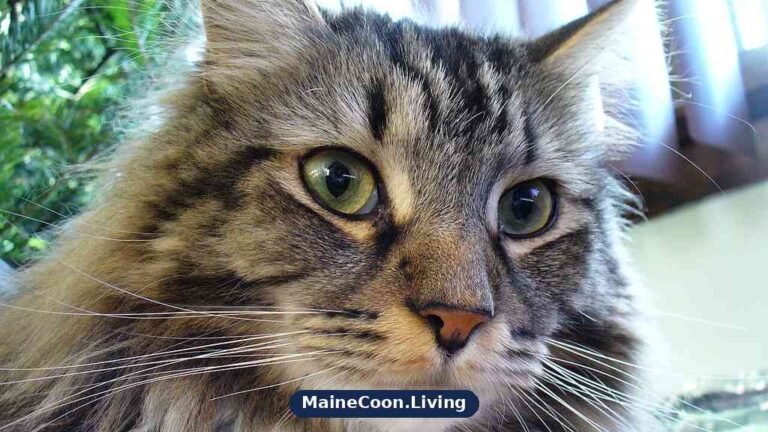
The eyes are large, oval in shape, and set wide apart with a slight slant toward the ears. They give the breed its open, friendly expression, which surprises people who expected something fiercer from such a big cat.
Gold, green and copper are the usual colours, and many cats sit somewhere in the green gold range. Blue eyes and odd eyes, one of each colour, appear mostly in white cats and cats with heavy white markings. Whatever the colour, the eyes should look bright and a little curious, because in my experience they usually are.
A Tail Like a Feather Duster
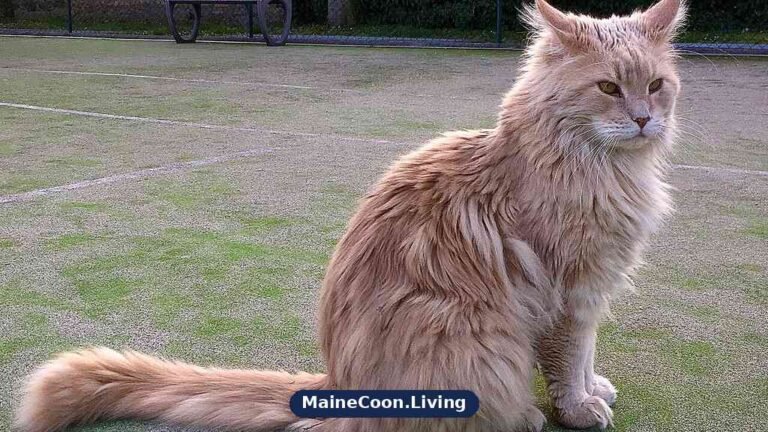
The tail is long, often close to the length of the body itself, and it is wide at the base before tapering toward the tip. The hair on it flows long and full, so the whole thing moves like a plume when the cat walks. Mine carries his high, like a flag announcing which room he is entering next.
That tail is not just decoration. It works as a counterbalance for a big cat jumping and turning, and in cold weather Maine Coons wrap it around their feet and nose when they curl up. If a cat’s tail looks short or thin haired next to its body, that is a point against it being a Maine Coon.
The Coat Has Three Layers
Run your hand down a Maine Coon’s back and you can feel the coat is engineered, not random. It is built in layers, and each layer has a job. That structure is what makes the fur look shaggy in some places and sleek in others.
Silky Topcoat Over a Soft Undercoat
The top layer is made of longer, silky guard hairs that lie smooth and shed water. Underneath sits a soft, fine undercoat that traps warm air against the skin. Together they handle snow and rain far better than the cottony coat of many other longhaired breeds.
The length is uneven by design. Fur stays shorter over the shoulders, then grows longer down the back, the sides and the belly. That uneven, shaggy finish is correct for the breed, and a perfectly even, puffball coat is actually a point against a cat.
The Ruff and the Britches
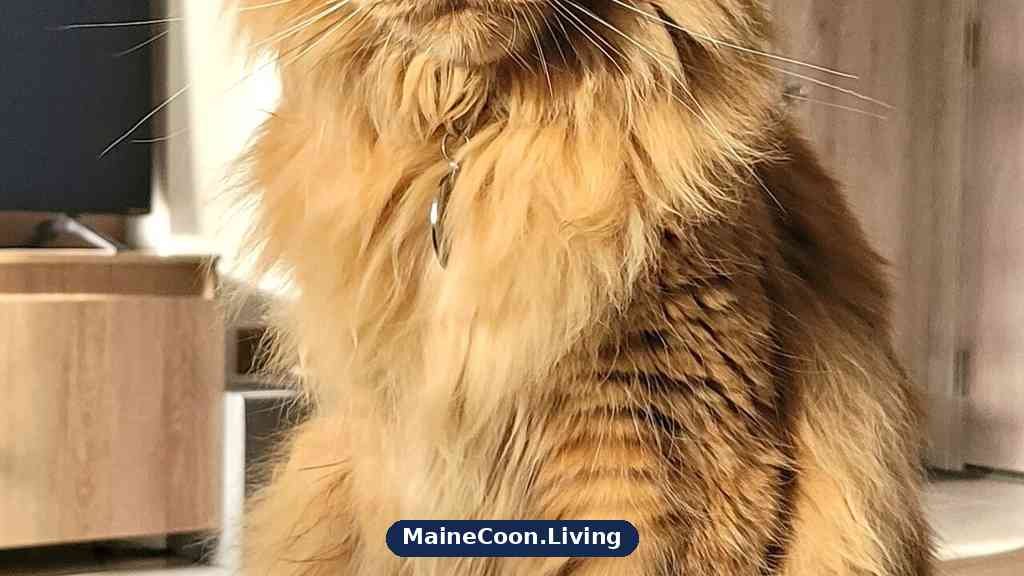
Around the neck, the coat grows into a full ruff, a sort of mane that frames the face. It is one of the last features to arrive, and plenty of young cats look a bit bare around the neck until their second or third winter. Owners waiting for the lion look mostly need patience.
On the back legs, the long hair forms what breeders call britches, fluffy trousers that cover the thighs. The belly fur grows long too, and the tail plume completes the picture. Put the ruff, britches and tail together and the cat looks dressed for weather most of us would stay indoors for.
Colour is the one area where almost anything goes. Solids, tabbies, tortoiseshells, smokes and every kind of white spotting all appear, and I walk through the whole palette in my Maine Coon colours hub. The main absences are the pointed pattern of a Siamese and the chocolate and lilac shades.
Paws Built Like Snowshoes
The paws are big, round and well tufted, with long hair growing between the toes. Spread out, they work the way snowshoes do, distributing a heavy cat’s weight over soft ground. The first time you shake paws with an adult male, the size of them is genuinely surprising.
Some Maine Coons are also polydactyl, which means they are born with extra toes. It gives the front paws a wide, mitten like look, and sailors once prized these cats on ships for their grip and balance. Extra toes are a charming piece of breed history, though not every show standard rewards them.
From Kitten to Adult, the Look Changes
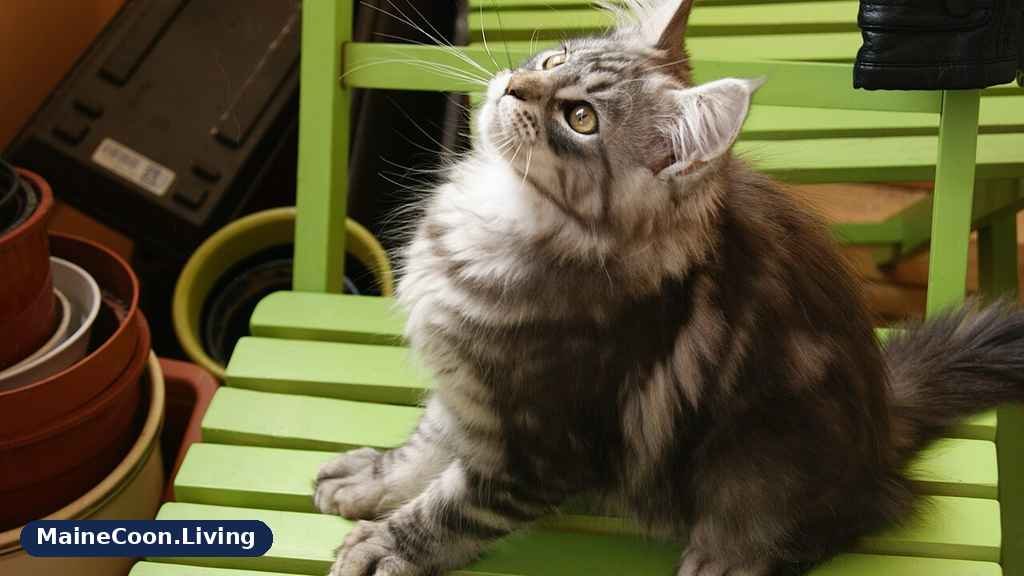
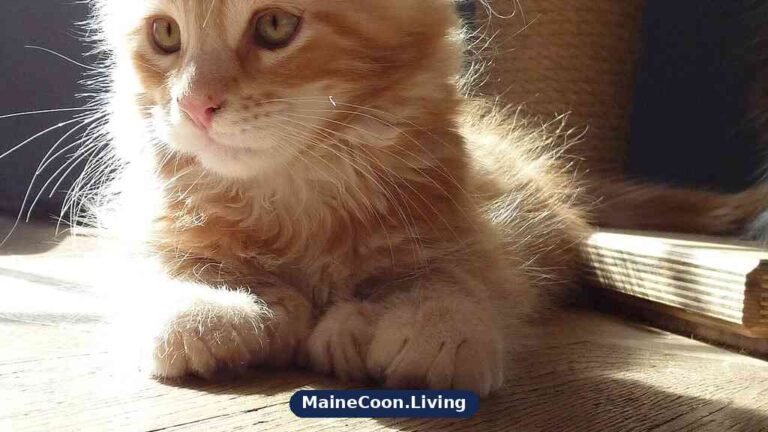
A Maine Coon kitten does not look like a small version of the adult, and this trips up a lot of new owners. Kittens are leggy, a little gangly, and their ears look oversized for their heads. The coat is shortish and soft, with no real ruff and only a hint of the britches to come.
The breed matures slowly, often taking three to five years to reach full size and coat. The body fills out first, the head broadens next, and the ruff and tail plume finish the job late. A two year old who still looks unfinished is not behind schedule, he is just being a Maine Coon.
Coats also change with the seasons. The undercoat thickens noticeably for winter and sheds out in spring, so the same cat can look far more dramatic in January than in July. If you are judging a cat from a single summer photo, keep that in mind.
Maine Coon or Just a Fluffy Lookalike?
Here is the honest part. No single trait proves a cat is a Maine Coon, because every one of these features shows up somewhere else. Big size appears in many mixed cats, ear tufts appear in other breeds, and long hair appears in half the shelter cats I have ever met.
What matters is the full stack together. Rectangular body, square muzzle with a firm chin, tall furnished ears, oval eyes, a layered and uneven coat, a tail nearly as long as the body, and oversized tufted paws. The more of those boxes a cat ticks, the stronger the case.
The Norwegian Forest Cat is the closest lookalike, and the one most often confused with this breed. Its head forms a straighter triangle with a long, unbroken profile, while the Maine Coon shows that gentle curve and boxy muzzle. Siberians run rounder in the head and body, and a domestic longhair, however beautiful, usually lacks the square muzzle and the sheer bone of the real thing.
European and American lines add one more wrinkle, since the European type often shows a stronger muzzle and a wilder expression. I compare the two in my piece on European vs American Maine Coons. And if you are working through the clues on your own cat, my guide on how to tell if your cat is part Maine Coon takes it one trait at a time.
The Checklist I Actually Use
When someone sends me a photo, I run down the same short list every time. Body first: long, rectangular, level backed, and heavy boned. Then the head: wedge shaped, with high cheekbones, a square muzzle and a chin you could set a ruler against.
After that I check the ears for height and furnishings, the eyes for that large oval shape, and the tail for length and plume. Finally I look at the coat pattern of growth, shorter on the shoulders and longer behind, with tufts between the toes. A cat that passes all of that has earned the benefit of the doubt.
Looks will only ever take you so far, and papers or a DNA test settle what eyes cannot. But as a first judgement, this checklist has never steered me wrong. And honestly, learning to read it is half the fun of living with one of these cats.
Frequently Asked Questions
What is the most distinctive feature of a Maine Coon?
If I had to pick one, it is the square muzzle paired with the tall, heavily furnished ears. Plenty of cats are big or fluffy, but that boxy muzzle and strong chin belong to this breed. The long plume tail and rectangular body complete a combination no lookalike quite matches.
Do all Maine Coons have lynx tips?
No, and this catches a lot of people out. Lynx tips are common and very desirable, but some purebred Maine Coons grow only short tips or none at all. The heavy hair inside the ear, called furnishings, is the more reliable sign to check.
How can I tell a Maine Coon from a Norwegian Forest Cat?
Look at the head in profile. The Maine Coon has a modified wedge with a gentle curve at the nose and a strong square muzzle, while the Norwegian Forest Cat has a straight, triangular profile. Maine Coons also tend to carry a shaggier, less even coat and a slightly bigger frame.
When does a Maine Coon get its full coat and ruff?
The full adult coat usually arrives between two and three years of age, and some cats keep maturing until four or five. Kittens look leggy and a bit scruffy first, and the ruff and britches fill in last. Winter coats also grow noticeably thicker than summer coats.
Can you tell a Maine Coon just by looking at it?
Looks give you a strong suspicion, not a guarantee. The full checklist of traits together points firmly at the breed, but plenty of mixed cats share several of them. Only pedigree papers or a DNA test can confirm breed ancestry for certain.

4 Comments