Best Cat Tree for a Maine Coon: Sturdy Picks That Fit a Big Cat
My first cat tree looked fine in the photographs online. It lasted about a month before the top perch began to tilt, and by the second month my cat was sleeping on the sofa arm instead.
Nothing had broken in a dramatic way. The joints had simply loosened under a cat who weighs far more than the slim tabby in the product pictures, and who lands rather than steps.
That is the lesson I keep coming back to with this breed. A Maine Coon does not need the tallest or prettiest tree in the shop, but he does need one built for his weight, his length and his confidence.
Why ordinary trees give up
Most standard trees are designed around a cat of perhaps 4 kilos. A healthy adult Maine Coon is commonly 6 to 9 kilos, with big males going beyond that, and the difference shows up in leverage as much as in weight.
Our guide to Maine Coon size sets out the full range these cats reach. It explains why furniture bought for an average cat is under strain from the very first week.
When a heavy cat sits near the edge of a high perch, the post below works like a lever. Every jump on and every jump off twists the joints a little, and board joints that felt firm in the shop can work loose at home.
The cat notices the movement before you do. A perch that shifts under his paws feels unsafe, so he either avoids the top level or leaves it in a hurry, which rather defeats the point of buying it.
Start with the base, not the top
Shoppers tend to look up at the cute top bed first. I now look down, because the base decides whether the rest of the tree is furniture or a slow accident.
For a tall tower I want a base of at least 60 centimetres square, and wider still once a tree passes about 150 centimetres in height. A broad rectangle can be even better than a square, because it resists tipping in the direction a cat actually jumps.
Weight in the base helps too. Lift the tree in the shop if you can, and favour the one that feels awkwardly heavy over the one that feels convenient to carry.
My rule is simple: if the base looks small in proportion to the top perch, walk away. No cushion, dangling toy or discount makes up for a footprint that cannot handle a landing cat.
Wall fixing is the other half of stability. A short strap or bracket into a solid fixing turns a nervous tower into something close to immovable, and I would anchor any tall tree in a Maine Coon home as a matter of course.
Perches that actually fit a long cat
Measure your cat asleep and stretched out, from nose to the base of the tail, then look for a top perch at least that long. Many Maine Coons need a platform around 50 by 35 centimetres at minimum, and more is welcome.
Round beds should be roughly 45 centimetres across or more. Anything smaller leaves hindquarters spilling over the edge, and a cat who cannot settle properly will not choose that spot for long sleeps.
Raised edges help, provided they are low and padded rather than a hard rim. A gentle lip stops a sleeping cat rolling towards thin air and gives him something to rest his chin on.
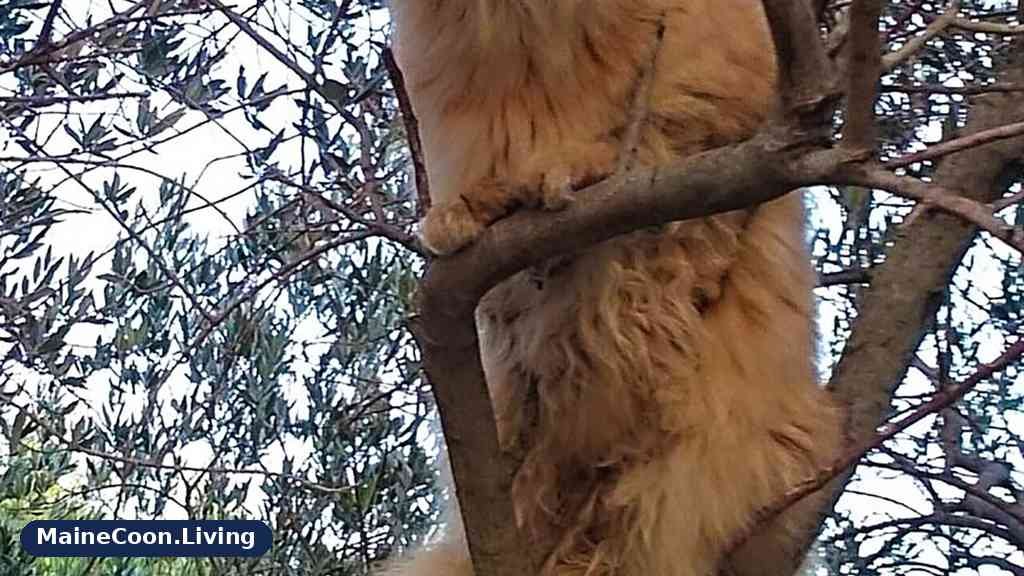
Spacing between levels matters as much as the size of each level. Platforms set too close together force a long bodied cat to fold himself awkwardly, while staggered levels with clear gaps let him climb in a comfortable curve.
Check any enclosed box with the same honesty. A hidey hole needs an opening wide enough for broad shoulders, plus enough room inside for the cat to turn around without wedging his tail against the wall.
How tall is sensible
Height is fun, but it is not the whole point. A tree between about 120 and 170 centimetres gives most Maine Coons a satisfying lookout while keeping fall distances and tipping forces within reason.
Floor to ceiling poles can work brilliantly because they brace against the ceiling rather than relying on a base alone. They still need correct tension and a check every few months, because a pole that slips is worse than no pole at all.
Senior cats, kittens and cats with stiff joints need a different calculation. Lower steps, a ramp or a sturdy low platform will get far more use than a heroic top perch they no longer trust themselves to reach.
If you are buying ahead for a growing kitten, think about the adult waiting inside him. Our Maine Coon kitten checklist is a useful reminder of how fast the small cat in front of you becomes a large one.
Posts and sisal that survive real scratching
Scratching is where cheap trees confess. Thin posts wrapped in loose rope look tidy on day one and then shed fibres everywhere once a big cat puts his shoulders into the work.
I look for posts at least 10 centimetres thick, wrapped tightly in sisal with no gaps showing the tube beneath. Run a thumbnail along the wrap in the shop; if it lifts, moves or feels slack, that post is already failing.
Height matters because scratching is also a stretch. A post should let your cat rise on his hind legs, reach high and pull down with his whole body, which usually means a clear scratching run of 80 centimetres or more somewhere on the tree.
Frame material decides how long any of this lasts. Solid wood and decent plywood hold their fixings through years of landings, while the cheapest board tends to crumble around its screws once the wobble starts.
Coverings are a practical choice rather than a style one. Removable washable pads beat glued on carpet in a house with a long haired cat, because hair, dust and the occasional hairball are all easier to deal with.
Three types, honestly compared
Tall towers
A well built tower gives climbing, scratching and a high bed in one footprint. The downside is bulk: the models strong enough for this breed are heavy, wide and rarely cheap, and they dominate a small room.
Wall shelves
Shelves and steps fixed into solid wall fixings take the cat’s weight through the wall rather than through a wobbling frame. They free up floor space and suit flats well, which is why our guide to apartment living with a Maine Coon keeps coming back to vertical territory.
The catch is commitment. Shelves need proper fixings into studs or solid masonry, they leave holes behind, and you cannot simply move them when you rearrange the room.
Low, wide platforms
A short, broad platform tree looks less exciting and is often the most used piece in the house. With less height there is less leverage, so stability is easier to achieve, and older cats can enjoy it without big jumps.
My honest view is that many homes do best with a hybrid. One solid low tower for sleeping and scratching, plus a couple of wall shelves for height, beats one giant tower that tries to do everything and sways while doing it.
Names I would look at, with the trade offs
People ask for brand names, so here is my opinionated shortlist rather than a sales pitch. Armarkat makes some very tall carpeted towers that many large cat owners swear by, though the coverings trap hair and some models still need wall anchoring to feel truly solid.
Frisco, the Chewy house brand, offers big heavy trees at saner prices, and the top perches on the larger models are genuinely roomy. The trade off is weight and assembly time, and quality varies between models, so check the base size of the exact one you are buying.
PetFusion takes the wall route with mounted climbers that look clean and take up no floor at all. I like the idea a lot for confident home improvers, but the total cost climbs once you add several pieces, and everything depends on your fixings.
New Cat Condos and similar solid wood makers sit at the plain and sturdy end of the market. They are not the prettiest objects, yet thick coverings, real timber and wide perches are exactly what a 9 kilo cat appreciates.
None of these names rescues a bad specification. Whichever badge is on the box, I still measure the base, the perch and the posts myself before any money changes hands.
Watch a sturdy build before you buy
If you are wavering between buying and building, this video of a heavy duty tree made for a young Maine Coon is worth your time. Watching the frame go together shows how much timber and bracing a genuinely solid tree involves.
Notice the difference between that frame and the thin tubes in many flat pack kits. It is a useful benchmark even if you never pick up a saw.
Where you put it decides whether it gets used
A tree pushed into a spare room is a tree ignored. Maine Coons are sociable cats who like to supervise the household, so the best spot is usually near a window in the room where you actually spend your evenings.
Keep some clear space around the top levels for jumping off, and think about what sits within launch range. Breakable ornaments on a nearby shelf will eventually meet a cat travelling at speed.
To launch a new tree, I cheat shamelessly. Treats appear on each level, a favourite blanket goes on the top perch, and play sessions with a wand toy happen around the posts for the first week.
The ASPCA guidance on general cat care makes the same broad point about home enrichment: cats use what fits naturally into their territory and daily routine. A well placed tree quickly becomes part of both.
The wobble test and monthly safety checks
Before your cat ever climbs a new tree, test it like a sceptic. Grip the top platform and push sideways firmly, then lean some of your own weight briefly against the posts.
A small amount of flex in carpet or padding is normal. Movement at the joints, a base that lifts at one corner, or a creaking post means the tree goes back, gets anchored, or gets reinforced before use.
Once it is in use, I give our tree a quick check every month or so. Bolts get tightened, sisal gets inspected for bare patches, and I look for sagging platforms or split coverings that could catch a claw.
Rewrapping a worn post with fresh sisal rope and pet safe glue is a short job that can save the whole tree. Letting a cat scratch through to the tube underneath teaches him that the post itself is fair game, which is harder to undo.
Retire anything that has cracked, split or started to sag under your cat’s weight. Cats are superb athletes, but a failed perch at height is how sprains happen, and how a confident cat becomes one who avoids trees altogether.
If you would rather build one
Building is not the cheap option it first appears, once you price decent plywood, thick posts and proper sisal. It is, however, the option where every dimension can be made right for your particular cat.
My starting points would be a heavy base wider than you think necessary, posts of 10 centimetres or more, and platforms cut generously rather than cleverly. Bolt joints where you can, sand every edge smooth, and anchor the finished thing to the wall.
A converted solid bookcase is the simplest build of all. Fix it to the wall, add carpet tiles or sisal mats to the shelves, put a washable cushion on top, and you have strong, honest cat furniture that also holds books.
Frequently Asked Questions
What size cat tree does a Maine Coon need?
Look for a top perch at least 50 by 35 centimetres, posts around 10 centimetres thick and a rating comfortably above your cat’s weight. A tree between 120 and 170 centimetres tall suits most homes. When in doubt, choose the wider and heavier option.
How wide should the base of a cat tree be?
For a tall tower, start at 60 centimetres square and go wider as height increases. The base should feel heavy before the cat ever touches it. Adding a wall strap or bracket makes a real difference to stability.
Are wall mounted shelves safe for a Maine Coon?
Yes, provided every shelf is fixed into a stud, solid masonry or proper heavy duty anchors. Fitted well, they carry a big cat with no wobble at all. Never rely on ordinary plasterboard fixings for a cat of this weight.
How tall should a scratching post be for a Maine Coon?
Aim for a clear scratching run of at least 80 centimetres so your cat can stretch fully on his hind legs. The post should also be thick, around 10 centimetres or more, with tightly wound sisal. A post that rocks when scratched will quickly be abandoned.
How do I stop a cat tree from wobbling?
Start by tightening every bolt and checking that the tree stands on a flat, hard surface rather than thick carpet pile. Anchor tall trees to the wall with a strap or bracket. If the joints themselves have loosened in the board, reinforcing or replacing the tree is safer than ignoring it.