Maine Coon vs Ragdoll: Which Fits Your Lifestyle?
I am Umar, and I live with a Maine Coon, so let me get my bias out in the open first. I write this site from inside Maine Coon life: the chirping at the window, the tail across my keyboard, the weekly battle with a comb. When friends ask me whether they should get a Maine Coon or a Ragdoll, my answer is never quick.
These are the two breeds people narrow it down to more than any others, and I understand why. Both are big, soft, people loving cats that look impressive in photos. Underneath that first impression, though, they live very differently, and the wrong match can frustrate both you and the cat.
For the Ragdoll side I am not going to pretend at ownership I do not have. What follows on Ragdolls comes from breed standards, registry descriptions and veterinary sources, checked against what Ragdoll owners consistently report. Where my own daily experience speaks, that is the Maine Coon talking.
So this is a genuine head to head. Temperament first, because that is what you actually live with, then size, coat, noise, energy, health and price. At the end I will give you a straight verdict based on the kind of owner you are, not on which breed I happen to share my home with.
Temperament comes first
Looks fade into the background within a month of living with any cat. Temperament is what is still there at year five, on a tired Tuesday, when the cat wants something at 6 in the morning.
How a Maine Coon loves people
A Maine Coon is social in a busy, involved sort of way. Mine follows me from room to room, supervises cooking from a safe distance, and greets visitors like a host who wants to check the guest list. The loyalty people describe as dog like is real: these cats bond hard, learn routines fast, and often learn their names and a few words besides.
But there is an independent streak running through all of it. A Maine Coon usually wants to be near you rather than on you, stretched out beside your chair instead of draped across your chest. I have written more about this balance in my guide to Maine Coon temperament, because it surprises people who expected a giant lap cat.
That independence is not coldness. My cat checks on me constantly, sleeps within sight of me, and complains loudly if a closed door separates us. He simply prefers companionship with a little personal space, and many owners find that easy company relaxing.
How a Ragdoll loves people
The Ragdoll was bred in California in the 1960s with temperament as the headline goal, and it shows. The TICA Ragdoll breed page calls the Ragdoll a relaxed, happy cat, and owner accounts line up with that wording to an unusual degree. This is a cat selected, generation after generation, to be handled and adored at close range.
The famous party trick is the flop. Pick up many Ragdolls and they go loose and heavy in your arms, relaxing their muscles the way a cloth doll would, which is exactly where the name came from. Not every Ragdoll performs on cue, but the tendency is a genuine breed trait and not just breeder marketing.
Where the Maine Coon is beside you, the Ragdoll is on you. Ragdolls are the true lap cats of this pairing, the ones who settle onto a person and stay there through a whole film. If your picture of cat ownership involves a warm, purring weight on your legs every evening, the Ragdoll was quite literally designed for you.
Clingy or content alone
Neither breed does well with a totally empty house, but they cope differently. A Maine Coon left alone for a normal working day will nap, patrol the windows and entertain himself, then give you a full report when you get home. A Ragdoll tends to wait by the door in spirit, and long daily absences can genuinely wear on this breed.
Think honestly about your schedule first. A home worker or a busy family house suits a Ragdoll beautifully, while a single person out for long hours will usually find the Maine Coon the more forgiving roommate.
Size and build
Both breeds sit at the big end of the domestic cat world, and both take their time getting there. Maine Coons and Ragdolls keep growing for years, often not filling out fully until they are three to four years old.
The Maine Coon is the taller, longer, more rugged of the two. Males commonly weigh 13 to 18 pounds, with some going past that, and females usually land between 8 and 12 pounds. The body is rectangular and muscular, the chest is broad, and the tail is long, plumed and carried like a flag.
The Ragdoll is heavy in a softer way. Males often weigh 15 to 20 pounds and females 10 to 15, so a big male Ragdoll can outweigh a Maine Coon on the scale. The build underneath is still substantial, but the overall impression is rounder and plusher, with a softer belly and a less angular face.
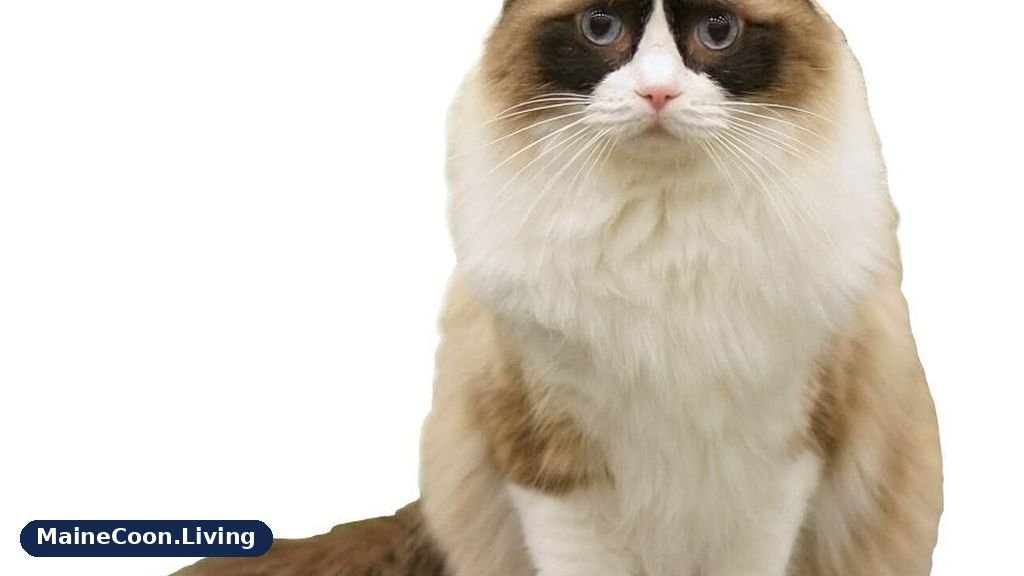
Colour works differently too. Maine Coons come in almost every colour and pattern, from brown tabby like mine to black, silver, red and tortoiseshell. Ragdolls are always colourpoint cats, with a paler body and darker face, ears, legs and tail, sometimes with white mittens or a white blaze.
If you want the full growth picture, my breakdown of Maine Coon size walks through weights and lengths month by month. Set beside a Ragdoll of the same age, the Maine Coon usually looks bigger even when the scale disagrees. Height, length and that huge tail create most of the effect.
Coat and grooming load
Here is where daily life with these two breeds really separates. Both look like high maintenance cats in photographs. In practice, one of them quietly is, and it is mine.
The Maine Coon double coat
A Maine Coon wears a double coat built for cold New England winters: a dense, soft undercoat under longer, slightly shaggy guard hairs. It is a practical, weather resistant jacket, and it feels wonderful when it is in good condition. Left alone, that undercoat packs down, tangles and mats, especially behind the ears, in the armpits, along the belly and at the back of the legs.
My routine is two to three proper combing sessions a week, and more when the spring shed arrives. A steel comb matters more than a fancy brush, because you need to get down to the skin and lift the undercoat out before it felts. I laid out the whole routine, tools included, in my guide on how to groom a Maine Coon cat.
The Ragdoll single coat
The Ragdoll coat surprises most people, because it looks like it should be harder work than it is. It is a single, silky coat with very little dense undercoat, and that one difference changes everything about upkeep. With far less undercoat to tangle into itself, the fur resists matting and mostly needs a light comb through once or twice a week.
The texture is often compared to rabbit fur: soft, plush and cool to the touch. Ragdolls still shed, particularly in spring, but grooming sessions are shorter, gentler and far less likely to turn into a wrestling match over a knot.
If grooming time is your deciding factor, score this round clearly to the Ragdoll. Ten easy minutes a week against half an hour of determined combing is a real lifestyle difference. It adds up over a fifteen year life together.
Who makes more noise
Nobody warns first time buyers about the soundtrack, so let me do it. Living with a Maine Coon means living with commentary. These cats rarely produce a plain, loud meow at you; instead they chirp, trill, warble and mutter in a running conversation that follows you around the house.
I find it charming, and most Maine Coon owners do. My cat announces his arrival in a room, answers when spoken to, and chirps at birds through the window with his whole body vibrating. But it is constant, and a person who works from home on calls all day, or who simply prizes a quiet flat, should hear that honestly stated.
The Ragdoll sits at the opposite end of the volume scale. This is a quiet, soft voiced breed that speaks in small, gentle sounds and saves its voice for real requests. Many Ragdoll owners say they hear their cat properly only at mealtimes or when a door has been shut against them.
So ask yourself one question: do you want a cat who talks to you, or a cat who whispers? Noise tolerance is one of the most reliable predictors of happiness with either breed.
Energy and play
A young Maine Coon is a busy animal. Mine still tears around the house in the evening at an age when many cats have settled into full time napping, and he treats wand toys, tunnels and puzzle feeders as serious work. These cats stay kittenish for years, climb enthusiastically, and in many cases enjoy water, training games and even fetch.
That energy asks something of you. A bored Maine Coon invents his own entertainment, and his inventions may involve your curtains or a cupboard he has learned to open. Twenty minutes of real interactive play a day, plus things to climb, keeps the peace in my house.
The Ragdoll plays too, and kittens and young adults can be properly boisterous, whatever the sleepy reputation suggests. As adults, though, most Ragdolls play in shorter, gentler bursts and then return to their favourite person or cushion. They are more likely to carry a toy to you and request a calm game than to bounce off your walls.
Watch the two breeds side by side in the video below and the difference in style becomes obvious within minutes.
Families with children split interestingly here. A Maine Coon gives older kids an active playmate for a lively house, while a Ragdoll gives younger children a patient, forgiving cat who rarely scratches and happily joins quiet play.
With other pets, both breeds have good reputations. Maine Coons usually get along well with cat friendly dogs, while Ragdolls slot into multi pet homes peacefully, since confrontation is not their style. I covered the friendship side generally in are Maine Coon cats friendly.
Health on both sides
I am an owner, not a vet, so treat this section as a map of what to discuss with a breeder and a vet, not as medical advice. Both breeds are generally sturdy cats with lifespans well into their teens. Both also carry known inherited risks, and pretending otherwise helps nobody.
The shared risk is hypertrophic cardiomyopathy, or HCM, a thickening of the heart muscle that is the most common heart disease in cats. The Cornell Feline Health Center guide to HCM explains how it develops and why screening matters. Known genetic mutations linked to HCM have been identified in both of these breeds, which is why responsible breeders test for them.
On the Maine Coon side, hip dysplasia is the other condition to know about. A big, heavy, slow growing cat puts real load on its hip joints, and breeding stock should be screened by X ray or through established registry schemes. Spinal muscular atrophy, a genetic condition affecting movement, also occurs in the breed and has a DNA test, so a good breeder can rule it out of their lines.
On the Ragdoll side, kidneys deserve the attention. Ragdolls have a known predisposition to polycystic kidney disease, where cysts develop in the kidneys, and they also show higher rates of certain bladder and kidney stone problems. DNA testing and ultrasound screening of breeding cats are the tools good breeders use.
What should you do with all this? Buy only from a breeder who shows you test results rather than describing them, keep either breed lean, and book a yearly vet check that includes listening carefully to the heart.
What they cost to buy
Prices vary a lot by country and by breeder, so treat these figures as a guide rather than a quote. A pet quality Maine Coon kitten from a reputable, health testing breeder commonly costs 1,000 to 2,500 dollars. Show and breeding quality cats sit higher, and unusually low prices usually mean the health testing has been skipped.
Ragdolls land in a similar band, typically 1,200 to 2,800 dollars for a pet kitten from a registered breeder, with top show prospects costing more. Because the Ragdoll look depends on careful colourpoint breeding, well established catteries tend to hold their prices. As with Maine Coons, a bargain Ragdoll is usually a warning sign, not a lucky find.
Running costs are close as well. Both breeds eat like the large cats they are, need big litter trays and sturdy scratching posts, and should see a vet yearly. The Maine Coon adds a little grooming equipment and time; the Ragdoll adds little beyond the basics.
Whichever breed you choose, put the money into the breeder rather than the accessories. Health testing and a kitten raised underfoot in a home are worth more than any fancy bed, and a well bred kitten is a fifteen year decision.
The verdict by owner type
After all of that, here is the honest summary. There is no winner in this comparison, there is only the better fit for your actual daily life, and the categories below are how that fit usually breaks down.
Choose the Ragdoll if this sounds like you
You want a true lap cat who chooses your legs over every cushion in the house. You are home a lot, or someone in the household is, and you like a quiet, soft voiced cat who rarely raises the volume. You want long fur without the heavy grooming schedule, and a calm, tolerant nature matters more to you than games and antics.
Ragdolls also suit apartment living and calmer households particularly well. Their exercise needs are modest and their temperament forgives gentle children. If cuddling is the main event for you, as I discuss from the other side in do Maine Coon cats like to cuddle, the Ragdoll was built around it.
Choose the Maine Coon if this sounds like you
You want an interactive companion: a cat who greets you, follows you, talks back in chirps and trills, and joins whatever you are doing. You enjoy play sessions, training games and a bit of cheerful chaos, and you do not mind a running commentary while you cook. You are willing to comb a thick double coat several times a week and to find long hairs on your clothes.
Maine Coons suit people who want a relationship with some give and take in it. The affection is deep and loyal, but it comes with opinions, routines and a streak of independence that many of us would not trade away. Living with one feels less like owning a decoration and more like sharing the house with a small, furry colleague.
Still torn between them
If you are still undecided, meet both breeds in person before you commit. Spend an hour at a breeder visit or a cat show, because the difference between beside you and on you is much clearer in a room than on a screen. Most people know within that hour which cat they keep thinking about on the drive home.
From my side of the fence, I would not swap my chirping, comb demanding Maine Coon for anything. But I have also watched a Ragdoll folded asleep across a friend’s lap and understood why someone would choose exactly that. Pick the life you want to live every day, and the right breed follows from it.
Frequently Asked Questions
Which is calmer, a Maine Coon or a Ragdoll?
The Ragdoll, and it is not especially close. Ragdolls were bred for a relaxed, easygoing nature and most are happy to spend long stretches resting near their people. Maine Coons are gentle too, but they stay curious and playful for years and need more daily interaction.
Do Ragdolls really go limp when you pick them up?
Many do, and that habit is exactly how the breed got its name. A well bred Ragdoll often relaxes completely in your arms instead of wriggling to get down. Not every individual does it every time, but the tendency is real and widely reported by owners and breed standards alike.
Which breed needs more grooming, a Maine Coon or a Ragdoll?
The Maine Coon needs noticeably more coat work. Its double coat has a dense undercoat that tangles and mats, especially behind the ears, under the legs and along the belly, so most owners brush two or three times a week. The Ragdoll has a single silky coat with little undercoat, and one or two gentle brushings a week usually keep it in good shape.
Are Maine Coons or Ragdolls better for first time owners?
Both can suit a first time owner who has done some reading first. The Ragdoll is the easier start for most people because it is calmer, quieter and needs less coat care. The Maine Coon asks for more play, more brushing and more tolerance for chirping, which some beginners love and others find tiring.
How long do Maine Coons and Ragdolls usually live?
Both breeds commonly live into their early to mid teens with good food, indoor living and regular vet care. Many Ragdolls reach their mid to late teens, while Maine Coons often land in a similar range when heart and joint issues are screened for and managed early. Breeder screening and weight control make a real difference for both breeds.