How to Tell If Your Cat Is Part Maine Coon: A Rescue Owner’s Checklist
When friends send me photos of a big fluffy rescue cat, the question is always the same. Is there Maine Coon in there, or does he just look the part?
I am Umar, and I live with Maine Coons, so I understand why that label feels exciting. I also know how often it gets guessed and stretched, which is why I built this checklist the honest way.
Work through each sign and grade it as you go. A few strong signs together mean far more than a long list of fluffy maybes.
How to Use This Checklist
Start with the whole cat, not a single photo or a single trait. Take notes over a few weeks, because growth, coat and habits show themselves over time.
I grade each marker below as a strong sign or as common in any longhair. That grading matters, because long hair alone fools more owners than any other clue.
For a clear picture of the breed standard, compare your notes with what a Maine Coon cat looks like in full. Then come back here and score your own cat without mercy or wishful thinking.
The Physical Checklist
No single physical trait proves anything on its own. The pattern is what counts, and the strongest cases tick most of these boxes at once.
Size and Slow Growth
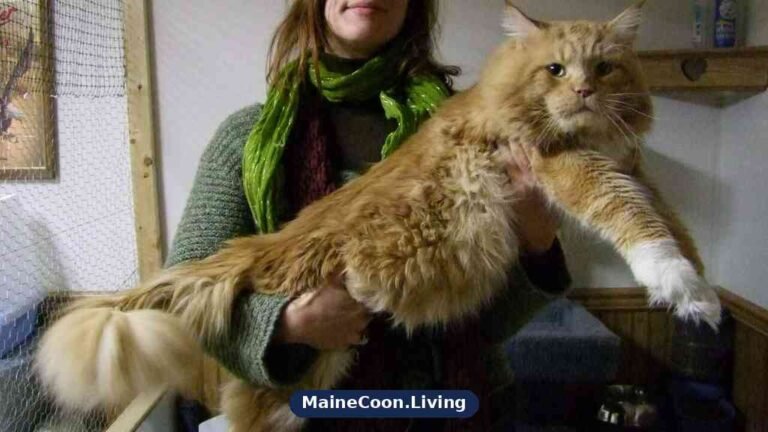
Strong sign when it comes with the right build. Maine Coons are large, heavy boned cats, and males in particular can look oversized next to an ordinary house cat.
The timing matters as much as the final weight. These cats keep growing slowly for three to five years, so a lanky young rescue may still be far from finished.
A heavy cat is not automatically a big boned cat. Read our Maine Coon size guide before you judge, and weigh growth and frame rather than belly.
Square Muzzle and Strong Chin
Strong sign, and one of my favourite clues. Look at the face from the front and the side, and look for a broad, squared off muzzle rather than a small pointed one.
The chin should look firm and solid, in line with the nose and not receding. High cheekbones and a gentle curve in profile complete a rugged, balanced head.
Photos at odd angles can hide or invent this shape. Judge it in person while your cat sits calmly and looks straight ahead.
Ears, Furnishings and Lynx Tips
Mixed grading, so look closely at the details. Large ears set high and wide, with thick furnishings inside the ear, point in the right direction.
Lynx tips are the small tufts rising from the ear tips, and they add to the case when the ears themselves are also large. Ear fluff alone is common in any longhair and proves very little.
Compare both ears in good light. Sparse wisps on small ears are a weak clue, while full furnishings on tall ears are harder to dismiss.
Cheek Ruff and Neck Mane
Common in any longhair, but the shape can help. A Maine Coon ruff frames the cheeks and chest with longer fur, often heavier in winter and lighter in summer.
The ruff should sit within an uneven, shaggy coat that is shorter on the shoulders. A perfect, uniform mane on a round faced cat is more show fluff than breed clue.
Run your hand gently around the cheeks and chest. You are feeling for length, density and that slightly rugged, weather ready texture.
Long Rectangular Body
Strong sign when you see it in motion. The body should feel long and rectangular, with solid muscle under the coat and a level back.
Stand back while your cat walks across the room. A long, sturdy frame looks very different from a compact cat hidden under a lot of fur.
Do not judge body shape from a curled up sleeping cat. Every cat looks round in a tight ball, and every coat looks thicker in winter.
Huge Bushy Tail
Strong sign when the length matches the plume. A Maine Coon tail is long, wide at the base and carried with full, flowing fur that can reach toward the shoulders.
Many mixes keep an impressive tail even when other traits are softer. A truly long and bushy tail on an otherwise plain cat deserves a high score.
A short fluffy tail is a weaker clue. Fluff without length is common in domestic longhairs and should not carry the whole case.
Tufted Snowshoe Paws
Strong sign when the paws are also oversized. Maine Coon paws are large and round, with tufts of fur between the toes that once helped on snow.
Check the paws while your cat rests with feet stretched out. Big, broad paws with clear toe tufts look like small snowshoes and stand out fast.
Small, neat feet point away from the breed. A big coat on small feet is one of the simplest reality checks in this whole list.
Water Resistant Double Coat
Strong sign in texture, not just in length. The coat has a heavier, slightly glossy top layer over a softer undercoat, and it sheds water better than a cotton soft coat.
Length varies across the body in a useful pattern. Fur is shorter on the head and shoulders, then longer on the back, sides, belly and tail.
A uniformly long and silky coat can still belong to a lovely mix. Uneven length with a practical, weather resistant feel is the more telling version.
The Behaviour Checklist
Behaviour never proves breed, and I want to be clear about that. It can still support a physical case, or quietly weaken one that looked good in photos.
Watch your cat for a week before you score these traits. One playful afternoon tells you less than the habits your cat repeats every day.
The comparison video above is useful because it sets Maine Coon size, character and love of water beside an ordinary house cat. Use it as a visual check, then return to your own notes.
Chirping and Trilling
Fairly distinctive when you hear it often. Many Maine Coons talk in soft chirps, trills and chirrups rather than plain, repeated meowing.
My own cats greet people and birds with those small, bright sounds. A rescue cat who narrates the day in trills is showing a habit worth noting.
Plenty of friendly cats are chatty in other ways. Treat voice as supporting evidence, never as a stand alone answer.
Dog Like Following
Common in bonded cats, but very typical here. Maine Coons often follow their people from room to room, wait near doors and join in with household routines.
Some learn games that feel almost dog like, including fetch and greeting visitors. That steady, social shadowing is part of why owners fall hard for this breed.
A devoted domestic longhair can do all of this too. Score it honestly, and remember that devotion says more about trust than ancestry.
Gentle Play
A soft clue that fits the wider picture. Play in this breed often stays gentle and kitten like for years, with big paws used with surprising care.
Look for a cat who plays hard without turning rough. Slow maturity shows up here as well, in both body and temperament.
Play style varies a lot between individual cats. It should never outweigh clear physical evidence in either direction.
Fascination With Water
Fun, memorable and only mildly useful. Many Maine Coons pat at taps, dip paws in bowls and watch running water like it is television.
That thicker, water resistant coat makes the habit easier to understand. A cat who seeks out water play earns a small extra mark on my list.
Many cats of no breed at all love a dripping tap. Enjoy the show, score it low, and move on to stronger signs.
The Honest Bit About Lookalikes
Here is the core truth of this article, and I will not soften it. Most cats who look like Maine Coons are domestic longhairs with no proven breed in them at all.
Domestic longhair is a description of coat and background, not a breed. Those cats come from the broad, random bred population that existed long before modern pedigree breeding.
That history explains the resemblance without any recent Maine Coon parent. Breeders selected and fixed traits that already appeared in ordinary longhaired cats.
Only pedigree papers prove a purebred, and appearance alone can never do that job. Without papers, even the most convincing rescue cat stays unproven, however striking he looks.
When a shelter calls a cat part Maine Coon, treat it as an educated guess. Staff make that guess from size and coat to describe a cat quickly and help him get adopted.
That guess is usually kind and often well meant. It is not a record of parentage, and it should never be repeated later as a confirmed fact.
Colour and Other False Clues
Colour is the clue I trust least of all. Maine Coons appear in many colours and patterns, which you can explore in our Maine Coon colours guide before you start matching photos.
The brown tabby look fools the most people. Tabby markings, including the forehead M, are normal for tabby cats everywhere and say nothing special about breed.
Long hair by itself is another weak clue. A big, fluffy coat on a small framed, round faced cat points toward domestic longhair, not toward this breed.
What Cat DNA Tests Really Do
DNA testing can add real information, as long as you read the result for what it is. It is a comparison tool, not a courtroom verdict on your cat.
Companies such as Basepaws and Wisdom Panel ask for a cheek swab from your cat. The lab reads markers in that sample and compares the pattern with its reference data.
International Cat Care has useful background on inherited disorders and careful genetic testing in cats at icatcare.org. Read it before you treat any home result as medical advice.
How the Comparison Works
Each company builds reference populations from cats of known breed. Your cat is then matched against those groups, and the report lists the breeds your cat resembles most closely.
Reports often show breed relatives and percentage style breakdowns. Those figures describe genetic similarity to the reference cats, not a family tree traced parent by parent.
Basepaws itself explains that similarity is not the same as proven ancestry. That single point will save you from most of the confusion around these reports.
What a Test Cannot Do
A home test cannot certify pedigree or register your cat as a purebred. Only documented lineage recorded by a recognised registry can do that.
It also cannot prove that a specific parent was a Maine Coon. The lab has no sample from either parent, so it cannot name the cats who produced yours.
Accuracy has real limits, especially for distant or heavily mixed ancestry. Reference data keeps growing, and results can shift as databases and methods improve.
When a Test Is Worth the Money
Buy one when curiosity is genuine and you will enjoy the report either way. A clear result can support a checklist case and give you a better sense of your cat.
The health screening side can also justify the cost. Marker results give you sensible questions for your vet about screening and monitoring as your cat ages.
Share any health flag with your vet before you worry or act. A marker is a prompt for a proper conversation, not a diagnosis on its own.
When I Would Skip the Test
Skip it if all you want is a label to repeat with certainty. The report will not give you that certainty, and you may feel let down by an honest result.
Skip it if the money is needed for vet care, food or grooming tools. Those things will improve your cat life this week, while a breed report changes very little.
Your money may also be better spent on a larger tree or carrier. A big framed cat will thank you for the space far more than for a percentage.
Same Cat, Same Care Either Way
Whether the answer is likely mix, possible mix or plain domestic longhair, your daily job stays the same. Feed well, groom the coat, keep up with vet visits and give your cat time and play.
Plan practically for the cat in front of you. A large, long coated cat needs sturdy furniture, roomy gear and a calm grooming routine, whatever his background turns out to be.
I love this breed, and I still say the label matters less than the cat. The rescue cat who follows you, trills at the window and sleeps on your feet is already the whole point.
Frequently Asked Questions
How can I tell if my cat is part Maine Coon at home?
Work through the physical and behaviour signs together, and look for several strong signs in one cat. Size with slow growth, a square muzzle, furnished ears and a huge tail carry more weight than fluff or colour alone. Even a strong match stays a good guess without papers or DNA evidence.
Can a DNA test prove my cat is part Maine Coon?
No, a home DNA test cannot prove it in the way pedigree papers prove a purebred. The test compares your cat with reference breed populations and reports genetic similarity and likely breed relatives. A clear Maine Coon result is useful evidence, but it is not a certificate and it cannot name a specific parent.
Are most cats called Maine Coon mixes really part Maine Coon?
Most are not, and most are best described as domestic longhairs with no proven breed ancestry. Shelters often use the label as a kind, educated guess based on looks, and that guess helps cats find homes. Your cat can look strikingly similar and still have no recent Maine Coon ancestor at all.
Does colour tell me if my cat is part Maine Coon?
Colour tells you almost nothing, because Maine Coons come in a wide range of colours and patterns. The classic brown tabby pattern is also the most common pattern in ordinary domestic cats. Judge face shape, body shape, coat texture and behaviour first, and treat colour as decoration.
Does it change how I should care for my cat?
The basics stay the same, with good food, fresh water, vet checks, play and regular grooming for any long coat. A larger cat may need a sturdier tree, a bigger carrier and a larger litter tray. Knowing a possible mix helps you plan for size and coat care, but it does not change daily love or routine care.