White Maine Coon Cats: Appearance & Personality
The first white Maine Coon I spent real time with did not look fragile at all. She was big, calm and completely sure of herself, with a thick ruff and a tail that seemed to arrive in the room before she did. What stayed with me was not just the colour, it was how much that one colour changes the questions you need to ask.
I am Umar, and I write this site as an owner and enthusiast, not as a vet. White looks simple on the surface, but underneath it sits genetics, eye colour, hearing and skin care, and I would rather explain those honestly than sell you a fairy tale.
If you want the full picture first, start with our hub guide to Maine Coon colours and then come back here for the deep dive on solid white alone. This page stays on that one colour from start to finish.
White Is a Mask, Not a Colour
The easiest way I explain it at home is this: white is a mask over the colour the cat was always going to be. A solid white Maine Coon still carries genes for another colour underneath, such as black, red or tabby, but you do not get to see them.
That hidden colour is not trivia, because it can peek out in kittens and it can show up in what a white cat passes on. Two white looking cats can produce kittens that surprise everyone if you do not know what sits under the mask.
The W gene in plain words
Cat geneticists call the cause the dominant white gene, written as W. Dominant means a cat only needs one copy to look white, which is why this colour can appear so reliably in a litter.
The W gene works early in development, before the coat has even grown. It stops pigment cells from spreading properly through the skin and fur, so the hair grows in without colour and the coat reads as white.
Those same pigment cells also have jobs in the eye and in the inner ear. That one fact explains almost everything else on this page, from blue eyes to the hearing link that white cat owners need to understand.
Not the same as albino
People often ask me if a white Maine Coon is an albino, and the answer is no. Albino cats lack pigment in a different and much rarer way, and they typically have very pale pink looking eyes.
A white Maine Coon has normal, vivid eye colour and pink skin in places like the nose and paw pads. The body can still make pigment, it simply does not reach the fur in the way it would in a coloured cat.
That distinction matters when you talk to breeders and vets. Calling every white cat albino muddles the health conversation and sends new owners looking for the wrong information.
That Little Smudge on a White Kitten
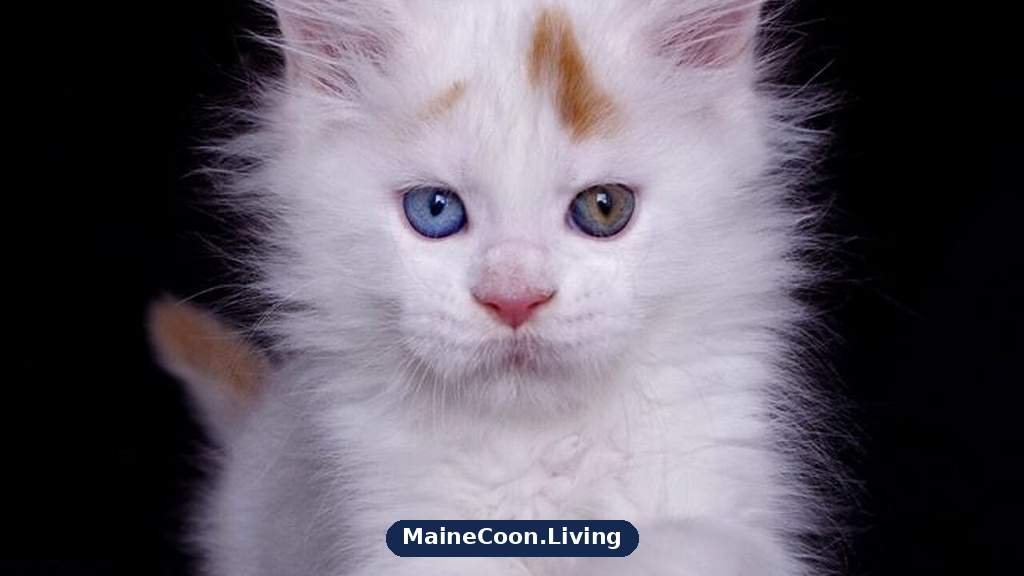
Many white kittens are not born looking perfectly blank. A lot of them arrive with a small coloured patch or smudge, most often on the top of the head between the ears.
I love that smudge because it gives the game away. It can be ginger, black, grey or tabby marked, and it hints at the colour hiding underneath the white mask.
New owners sometimes worry that the patch means the kitten is not really white. It does not, and in most kittens the smudge softens week by week and then fades away as the adult coat comes in.
By the time the cat is grown, the forehead is usually clean white and you would never guess the mark was there. If a breeder has early kitten photos, ask to see them, because that little patch is a small piece of your cat’s story.
The featured photo for this page shows exactly what I mean. Look closely at the kitten’s forehead and you can see the faint colour that most people would miss at a glance.
Eyes That Do All the Talking
Against a white coat, eye colour becomes the whole expression of the face. White Maine Coons can have blue eyes, gold eyes, green eyes, or one eye of each colour, and every combination looks strikingly different.
Eye colour in a young kitten is not the final answer. Kittens start with blueish eyes, and the true colour settles over the first weeks, so a good breeder will not promise a final shade too early.
Blue eyes
Two blue eyes on a big white Maine Coon is the look most people picture first. Blue here is not a pigment colour in itself, it is what you see when pigment is missing from the front of the iris and light scatters back.
Blue eyes are beautiful, and they are also the combination most closely linked to hearing loss. That does not make a blue eyed cat a problem cat, it just means hearing should be tested and not assumed.
Gold and green eyes
Plenty of white Maine Coons have gold, copper or green eyes, and in person they can be just as arresting as blue. Gold against white looks warm and steady, while green has a cooler, almost glassy quality in bright light.
These cats have pigment in the iris, which is why the colour shows. Statistically they have a lower chance of being deaf than blue eyed whites, although the risk does not drop to zero.
If you compare colours side by side, our guide to the black Maine Coon is a useful contrast. Black and white sit at opposite ends of the pigment story, and reading both makes the genetics much easier to picture.
Odd eyes, one of each
Odd eyed cats have one blue eye and one eye of another colour, usually gold or green. The proper word is heterochromia, but most owners just say odd eyed, and everyone knows what they mean.
Each side of the face can look like a different cat in photographs. Owners tend to have a favourite side, and kittens with odd eyes are often the first ones people ask about in a litter.
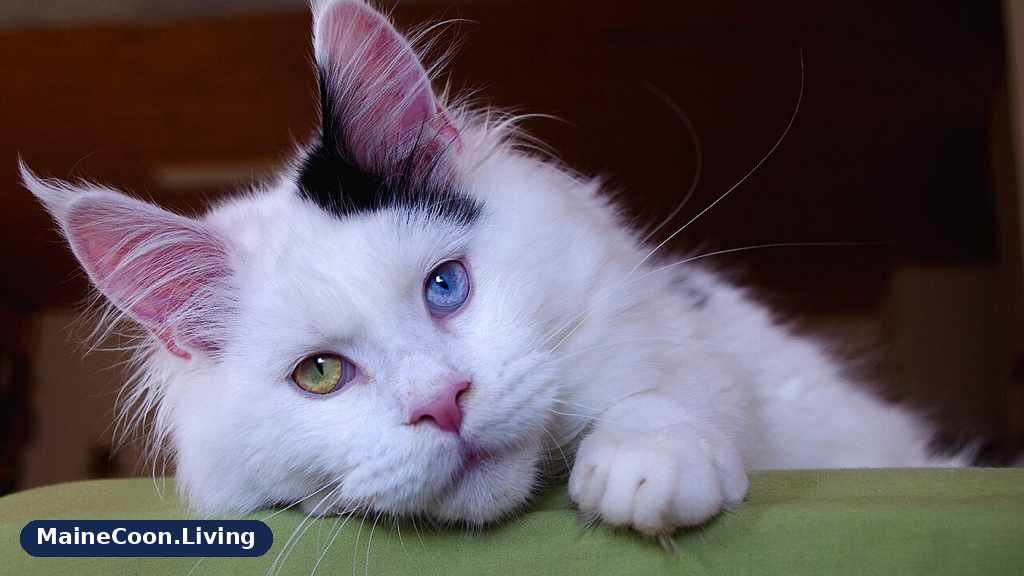
Odd eyes tell you the white gene did not act in exactly the same way on both sides. That uneven effect is also why hearing, when it is affected in an odd eyed cat, is so often affected on the blue eyed side only.
Hearing, Blue Eyes and Honest Numbers
This is the section I most want people to read slowly and without panic. There is a real link between the dominant white gene, blue eyes and deafness from birth, and pretending otherwise helps nobody.
At the same time, deafness is not a life ruined. I have seen deaf cats read a room brilliantly, learn routines quickly and bond hard with their people, so let us deal with the facts and then with the living.
The figures most often cited come from research summarised by the Cornell Feline Health Center, and I checked the numbers on this page against that source. Cornell reports that about 17 to 22 percent of white cats with no blue eyes are born deaf in one or both ears.
With one blue eye, that figure rises to about 40 percent. With two blue eyes, researchers found that about 65 to 85 percent of all white cats are deaf on one side or both, which is a wide range but a serious one.
Read those numbers carefully, because they include cats deaf in only one ear. A cat who cannot hear on one side may pass every casual home test, follow you happily and respond to your voice without any obvious sign.
That is why eye colour is a risk guide, not a diagnosis. Some blue eyed white cats hear perfectly, some gold eyed white cats do not, and only proper testing sorts one from the other.
The video above shows two white Maine Coon sisters from Felis Gallery, and it gives a good sense of scale. Watch how much presence a white coat has on a large framed cat, even without any other colour to help it.
Why the ear is involved at all
The inner ear needs pigment cells to help it develop and keep working normally in the first days of life. When the W gene limits those cells, the delicate structures that detect sound can break down very early.
This type of deafness is present from birth and it is not caused by infection, wax or age. It also does not get better with treatment, which is why honest testing and indoor safety matter more than hopeful waiting.
I am not a vet, and hearing questions belong to a vet or a testing centre, not to an article. What I can do as an owner writer is insist that you ask for the test result instead of accepting a guess.
BAER testing, explained simply
BAER stands for brainstem auditory evoked response, and it is the standard hearing test for cats. Small sensors record how the brain responds to clicks played into each ear, one side at a time.
The test does not hurt, although some cats need light sedation to stay still enough for a clean reading. Its big advantage is that it tests each ear separately, so it can find one sided deafness that owners and breeders would otherwise miss.
Any breeder offering white kittens should be able to show BAER results for those kittens. If a seller waves the question away or says they can tell by clapping, I would walk away and find a breeder who tests.
Living well with a deaf cat
A deaf Maine Coon should live indoors, and I would say that plainly to any owner. A cat who cannot hear traffic, dogs or a shouted warning needs a home where those dangers are kept on the other side of the door.
Inside, life adjusts in small and rather lovely ways. You get attention with a hand signal, a light flicked on and off, or a gentle tap that sends a vibration through the floor.
Approach a sleeping deaf cat gently and let them see your hand before you touch them. A startled cat is not a badly behaved cat, and most learn your routines so well that visitors do not realise they are deaf at all.
Deaf cats can be vocal, sometimes louder than hearing cats, because they cannot judge their own volume. Most owners find the chirps and trills charming rather than a problem, especially once the cat settles into the household.
Pink Skin, Sun and Tender Ears
Under that white coat, the skin is pink and short on protection. There is little pigment to shield the nose, eyelids and ear tips, and those are exactly the places where the fur is thinnest.
Sunburn on a white cat is not a minor cosmetic issue. Repeated burning on the ears can damage skin over time and raises the risk of serious skin disease, including cancer on exposed ear tips.
My rule is simple and cautious: enjoy a sunny windowsill, but avoid long stretches in harsh midday sun. If your cat loves a garden, give real shade, bring them in during the strongest hours and make indoor life interesting enough that they do not miss it.
Check ear edges regularly for redness, flaking, crusting or sores that do not heal. Any change like that deserves a vet visit rather than a wait and see approach, because early skin problems are far easier to deal with.
Do not put human sunscreen on a cat unless a vet has told you to use a specific pet safe product. Cats groom what you apply straight off their skin, and ingredients that are fine for us are not always fine for them to swallow.
Keeping a White Coat Actually White
Here is the unglamorous truth I tell every prospective owner: a white Maine Coon shows your housekeeping. Dust, food, litter and garden soil all announce themselves on that coat in a way they never would on a tabby.
The good news is that the routine is not difficult, it is just regular. Little and often beats a heroic grooming session once a month, for both the coat and your relationship with the cat.
Tear stains, paws and litter dust
Light rusty staining under the eyes is common on white faces and it stands out a mile. Wipe the eye corners gently with a damp cloth each day, and ask a vet if the eyes water a lot, because staining can follow irritation or blocked drainage.
Paws pick up litter dust and carry it through the house and back into the coat. A low dust litter, a mat outside the tray and a quick paw check after digging sessions all help keep the legs and belly brighter.
Food can mark the chin and chest ruff, especially with wet meals and a big bib of fur. A shallow bowl and a quick wipe after meals will save you a surprising amount of yellowing over the years.
Brushing and bathing
Brush a white Maine Coon two or three times a week, working through the ruff, armpits and trousers where mats start. Brushing removes loose hair and surface dirt before it works deeper into the coat, and it spreads natural oils that keep white fur looking clean rather than chalky.
Bathing is occasional, not weekly, unless your vet advises otherwise. Use a gentle shampoo made for cats, rinse very thoroughly, and expect the whole job to be easier if you start when the cat is young and treat it as a calm routine.
Dry the coat fully, right down to the undercoat, because a damp Maine Coon coat can tangle as it dries. A clean, well dried white cat in good light is honestly one of the finest sights in the cat world, and it is worth the effort.
One last practical point: white cats moult just as much as any other Maine Coon, the hairs are simply easier to see on dark clothes and furniture. A lint roller by the door is not vanity, it is basic equipment for living with this colour.
Before You Bring One Home
Choose the breeder before you fall for a kitten photograph. For a white kitten I want to see BAER results, normal breed health screening for the parents, and kittens raised in a home where they are handled every day.
Ask what colour the parents carry underneath and whether there is a kitten smudge photo from the early weeks. A breeder who understands the W gene will answer those questions happily and in plain language.
Then be honest with yourself about the daily side of white. If a marked coat, daily eye wipes and strict indoor living for a deaf cat sound like burdens, pick another colour and enjoy it fully instead.
If none of that puts you off, a solid white Maine Coon is a remarkable companion. Big, gentle, funny and visually unlike anything else in the house, they earn every bit of the extra care they ask for.
Frequently Asked Questions
Are all white Maine Coons deaf?
No, and that matters. Hearing loss is much more common in white cats, especially those with blue eyes, but many white Maine Coons hear normally in both ears. Only a BAER test can tell you for certain, because a cat deaf in one ear often behaves as if nothing is wrong.
Why do some white kittens have a coloured smudge on the head?
That smudge is a small glimpse of the colour the kitten carries underneath the white. The dominant white gene masks the true colour in most of the coat, but a patch on the head can show through in the first weeks and months. It usually fades as the kitten grows, leaving a solid white adult coat.
Do odd eyed white Maine Coons always lose hearing on the blue side?
No, not always, but the pattern is common enough to take seriously. When an odd eyed white cat is deaf in one ear, that ear is usually on the same side as the blue eye. A BAER test is still the only reliable way to know, rather than guessing from eye colour alone.
Can a deaf Maine Coon live a normal life indoors?
Yes, deaf indoor cats can live full and settled lives. They learn hand signals, watch faces and body language closely, and pick up vibrations through the floor. The main change is safety, so keep a deaf cat indoors and get their attention visually or with a gentle floor tap.
How do I protect a white Maine Coon from sunburn?
Keep midday sun time short and give your cat shaded, indoor options on bright days. The ears, nose and other pink or thinly furred areas burn first, so check them often for redness or crusting. If you notice sore or changing skin, see a vet promptly and ask before using any sunscreen product.