Orange Maine Coon Cats: Colors, Traits & Care Guide
People ask for an orange kitten, then a breeder answers with a red one, and for a second both sides think they are talking about different cats. They are not. I am Umar, I live with Maine Coons, and this is the colour I get asked about more than any other.
Registries call this colour red. Owners call it orange, ginger, marmalade, or whatever name fits the cat asleep on their sofa. In this guide I will stick mostly to orange, because that is what most families search for and say out loud.
One warning before the cute part. If you fall for this colour, you need to understand the gene behind it, because that gene decides the likely sex of your kitten, the pattern you will see, and even the little freckles that may turn up later.
Red on paper, orange at home
The Cat Fanciers’ Association breed standard lists red as deep, rich, clear and brilliant, with brick red nose leather and paw pads. That is the show language. At home the same cat can look like apricot in morning light and like copper by evening.
That shift is normal for a long coat. Light moves through guard hairs of different lengths, so the ruff often looks paler than the back and the tail can look darker than the chest. A photo rarely captures the shade you will live with, so meet the cat if you can.
For the full map of solids, tabbies, smokes and patched coats, start with our hub on Maine Coon colors. This page stays with one colour only, and goes deeper on it than a general chart can.
The gene sits on the X
Cat colour starts with pigment. Most pigment cells can make dark pigment, but the orange version of the gene pushes those cells to make a red yellow pigment instead. The result is fur that reads orange rather than black or brown.
The important detail is where that gene lives. It sits on the X chromosome, one of the two sex chromosomes. That single fact explains the sex ratio, the patched coats on many females, and why breeders can predict some litters with surprising confidence.
Think of the X as a page of instructions that every kitten reads. A male kitten gets one X page, from his mother, and a Y from his father. A female kitten gets two X pages, one from each parent, and both pages get a say.
Why most orange cats are boys
A boy needs only one orange instruction to be fully orange. If the single X he inherits from his mother carries orange, his whole coat follows it. There is no second X in the way to argue for a different colour.
A girl needs orange on both of her X chromosomes to be fully orange. If she gets orange on one X and non orange on the other, she usually ends up patched, with areas of orange and areas of dark colour in one coat. That patchwork is the root of tortoiseshell and calico coats.
Put those odds together and the numbers make sense. Around 80% of orange cats are male and around 20% are female, a ratio you will see cited by vets and genetics writers again and again. It is not a breeder sales line, it is simple counting.
What an orange girl needs
Every orange female needs an orange father. Her father has only one X to give his daughters, so that X must carry orange for her to stand a chance. If dad is not orange, his daughters will not be fully orange either.
She also needs a mother who carries orange. Mum must pass orange on the X she gives, either because mum is orange herself or because mum carries one orange copy in a patched coat. When both of those pieces line up, orange daughters appear, and breeders who plan for them are not guessing.
This is also why an orange female can feel harder to find. You are not just waiting for a colour, you are waiting for a specific pairing and then for the right kitten in that litter. If your heart is set on a girl, expect a longer wait and be honest with breeders early.
Never truly solid
Here is the fact that surprises new owners most. Orange cats are never truly solid, because the orange gene cannot switch the tabby pattern off. The pattern stays written into the coat no matter how even the colour looks from across a room.
Look closer and you will find it. There is usually a faint M shape on the forehead, bars on the legs, rings on the tail, and paler areas around the chin and eyes. Kittens can look quite plain at first, then the markings strengthen as the adult coat comes in.
So every orange Maine Coon is a tabby, even when a listing calls the cat solid red. Sometimes the contrast is bold and obvious. Sometimes you only see the pattern when sunlight rakes across the coat, but it is there.
Classic, the swirled look
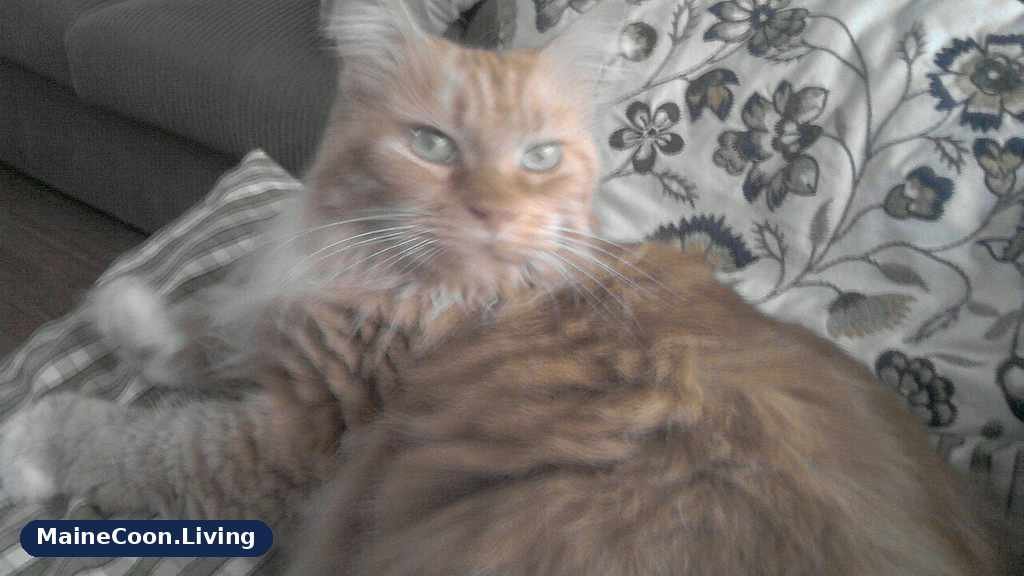
Classic tabbies wear broad, swirling markings that loop across the sides. People often describe a bullseye or an oyster shape on the flank, and on a big Maine Coon there is a lot of flank to show it. This is the pattern in the photo above, sometimes called blotched by European registries.
Classic suits this breed well because the long fur softens the edges of the swirls. The pattern looks painted rather than drawn. In deep red it can look almost marbled, especially around the shoulders.
Mackerel, the striped look
Mackerel tabbies wear narrow stripes that run down from the spine, a bit like fish bones. The lines are thinner and closer together than classic markings. On orange cats the stripes are usually a deeper shade of red over a lighter ground colour.
Legs and tails tell the story fastest here. Even a mackerel cat with a quiet looking back will show neat bars low down and clear rings near the tail tip. Those small clues are often clearer than the body pattern in long fur.
Ticked, the quiet look
Ticked tabbies are the subtlest of the three. Each hair carries bands of light and dark colour, so the body looks flecked and warm rather than striped. The clearest tabby signs are left on the face, legs and tail.
People who want an almost solid orange cat often end up loving ticked cats most. From a distance the coat can read as one glowing shade. Up close it has depth and movement that a flat colour would not have.
Shades, from cream gold to deep red
Orange in this breed is a range, not a single paint swatch. At the pale end you get soft cream gold cats, sometimes so light they are listed as cream, which is the dilute form of red. In the middle sits the warm apricot and marmalade colour most people picture first.
At the deep end the coat turns rich red, almost mahogany in shadow. Two kittens from one litter can land in different places on that range, and both are still correctly orange family cats. Shade alone tells you nothing about health or quality.
Age changes the picture too. Kitten fluff is often paler and less even, while the adult coat deepens over the first two to three years as the ruff and tail fill out. Judge a very young kitten by the parents if shade matters a lot to you.
Sun and season play a smaller part. A coat can look a touch lighter after months of bright windowsill naps, and a fresh winter coat often looks richer than a shedding summer one. Good food and regular grooming keep the colour looking its best, but they cannot rewrite the genetics.
This grooming video shows an orange Maine Coon named Ollie up close, and it is a good way to see the shade, size and coat texture in real light. Watch how the markings stay visible through the long fur, even on a cat who looks quite even in colour at first glance.
Freckles on the nose and lips
Many orange cats develop small dark freckles on the nose, lips, eyelids or gums as they age. The condition is called lentigo, and it is linked to the same pigment system that makes the coat orange. Spots often start small in young adults and slowly become more numerous over the years.
In most cats these freckles are harmless. They stay flat, grow slowly, and cause no pain or itching. I treat them the way I treat grey hairs on myself, as a normal sign of time passing rather than a problem to fix.
Still, not every new dark spot deserves a shrug. Book a vet visit if a spot grows fast, becomes raised, bleeds, changes shape in an uneven way, or seems to bother your cat. A quick look gives peace of mind, and International Cat Care is a sensible place to read more about general cat health checks.
Photos help more than memory here. Take one clear picture of your cat face every few months in similar light. If you ever need to show your vet how a mark has changed, that simple habit will answer the question in seconds.
The orange behaviour story
You have probably heard the jokes. Orange cats are chaotic, affectionate to a fault, and said to share one brain cell between the whole population. The stories are fun, and almost every orange cat owner I know repeats them with love.
Here is the honest part. Surveys do find that people tend to describe orange cats as friendlier than cats of some other colours. That tells us something real about human perception, and maybe about how people treat cats they expect to be friendly.
What surveys do not prove is that the colour gene changes personality. No solid body of evidence shows orange pigment rewiring the brain or making a cat wilder, braver or more loving. When researchers control for sex, breed and home life, the colour claim gets very thin.
Sex may explain part of the myth. Since most orange cats are male, and male Maine Coons are often a bit larger, bolder and more in your face than females, people may credit the coat for traits that were really about the individual cat. Upbringing does the rest, because a kitten handled gently and often usually grows into a sociable adult.
In this breed, temperament comes from breeding and early life first. Maine Coons as a group are people focused, playful and slow to mature, whatever colour they wear. Pick a kitten for character and health testing, then enjoy the orange jokes as jokes.
Living with the colour
Orange fur shows up honestly on dark sofas and quietly on light wood floors. You will see shedding season in full, especially when that pale undercoat lets go in spring. A comb two to three times a week keeps loose hair on the brush instead of on your clothes.
The coat itself needs no special colour products. Skip shampoos sold with promises to brighten or deepen red, because a healthy coat already shows its true shade. Regular grooming, decent food and parasite control do more for shine than any tinted product ever will.
Compare that daily reality with a very different look in our guide to black Maine Coon cats. The care is much the same, but black coats hide loose hair and dirt in a way orange coats simply do not. Knowing that trade off matters more than most buyers expect.
Eyes complete the picture in orange cats. Gold, copper and green gold eyes are common, and the warm eye colours against warm fur can look almost matched on purpose. White markings, when they appear on the chest, paws or belly, sharpen that contrast even further.
Choosing an orange kitten well
Start with health, not shade. Ask about screening for the known Maine Coon issues, meet the parents when you can, and watch how the kittens behave with people. A confident, curious kitten from tested parents is a far better bet than a perfect shade from a vague background.
Be flexible if you can. If you insist on an orange female in one exact shade and one exact pattern, your wait could stretch across many litters. If you can accept an orange boy, or a slightly paler girl, good breeders will usually have more honest options for you.
Rescue is worth a look too. Orange Maine Coons and Maine Coon type cats do appear in breed rescues and general shelters, and adult cats have the advantage of a known size, shade and character. The cat you meet is the cat you get, with no kitten guesswork.
An orange Maine Coon gives you the full breed in its warmest wrapping. Big frame, kind nature, a coat that glows in ordinary room light, and a little genetics lesson walking around your home. Learn the gene, expect the tabby markings, and choose the cat in front of you rather than a myth about his colour.
Frequently Asked Questions
Are orange Maine Coons always male?
No, but most of them are. About 80% are male because a boy needs only one copy of the orange gene, while a girl needs two. Orange females are less common, not impossible or unhealthy.
Why is my orange Maine Coon never solid in colour?
The orange gene cannot switch the tabby pattern off, so stripes, swirls or ticking always show through. Even the palest cat will reveal markings on the face, legs and tail. Every orange Maine Coon is a tabby underneath the name.
What is the difference between red, orange and ginger?
They describe the same colour in different words. Registries list the colour as red, while owners usually say orange or ginger at home. Cream is the paler dilute version of the same colour family.
Are the black freckles on an orange cat normal?
Small dark spots on the nose, lips and gums are often lentigo, and they tend to appear as orange cats get older. They are usually harmless and need no treatment. Ask your vet to look if a spot grows, rises, bleeds or changes quickly.
Do orange Maine Coons really act wilder than other colours?
There is no solid evidence that the orange gene changes personality. People often say orange cats seem friendlier in surveys, but that is perception, not proof of a behaviour gene. Breeding, early handling and home life shape temperament far more.

One Comment